

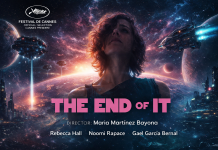


The 2026 Cannes premiere of “The End of It” is a film so achingly self-important, so drenched in its own existential hand-wringing, that one almost expects the credits to roll to the sound of a collective, bored sigh from the audience.
María Martínez Bayona, in her feature debut, has crafted a future so sterile, so painstakingly curated, that even the robots seem on the verge of requesting early retirement.
And at the center of it all, Rebecca Hall’s Claire—a woman who has lived for a quarter of a millennium—decides, with all the dramatic flair of a teenager slamming a bedroom door, that she’s had enough.
Imagine, if you will, a world where death is optional, where the ultra-rich sip immortality like a particularly exclusive vintage, and where the biggest crisis of the age is not climate collapse or social inequality, but the sheer ennui of eternal life.
Claire, our protagonist, dwells in a Mediterranean paradise so pristine it might as well be an IKEA showroom, complete with a husband (Gael García Bernal, looking perpetually bewildered) who adores her, a daughter (Noomi Rapace, delivering stoicism with the precision of a Swiss watch) who barely knows her, and a robot assistant (Beanie Feldstein, channeling the enthusiasm of a golden retriever who’s just discovered caffeine) programmed to keep her alive at all costs.
And yet, Claire is bored.
Bored of perfection, bored of youth, bored of a life so devoid of struggle that her greatest rebellion is to stop taking her vitamins.
The film’s opening act is a masterclass in understated satire—if by satire, you mean watching a woman blow out 250 birthday candles with the enthusiasm of someone filling out a tax return.
The production design is immaculate, a future so sleek and minimalist that it feels less like a vision of tomorrow and more like the world’s most expensive Airbnb.
Blood cleanses are performed over breakfast, bone replacements are scheduled between brunch and a nap, and the only thing more artificial than the characters’ organs is the emotional depth of their conversations.
Claire’s decision to embrace mortality is met with gasps of horror from her social circle, as if she’d announced she was switching to a budget brand of champagne.
But here’s the rub: “The End of It” wants to be profound.
It wants to be a searing indictment of privilege, a meditation on the human condition, a bold statement on the nature of art and legacy.
What it actually is, for much of its bloated 142-minute runtime, is a series of beautifully shot, impeccably acted vignettes in which very attractive people argue about whether it’s more pretentious to turn one’s death into performance art or to keep living in a world where the biggest problem is that your robot vacuum keeps bumping into the walls.
Rebecca Hall, ever the chameleon, sells Claire’s existential despair with a mix of wit and weariness, but even she can’t quite elevate the material above its own self-seriousness.
When she starts growing gray hairs and wrinkles—gasp—the film treats it like a tragic unraveling, as if aging were a fate worse than, well, eternal life.
The satire, when it lands, is sharp.
The idea that immortality is a privilege reserved for the elite, that someone must die for another to live or procreate, is a darkly comic jab at capitalism’s most grotesque excesses.
But the film’s tone lurches wildly between dry humor and earnest melodrama, never quite deciding whether it wants to mock its characters or weep for them.
The final act, in particular, feels like a mad scramble to inject some emotional weight into a story that has, up until that point, been more concerned with aesthetics than substance.
And when the credits finally roll, one is left with the nagging suspicion that “The End of It” is less a bold artistic statement and more a very expensive, very well-dressed shrug.
Yet, for all its flaws, there’s something undeniably compelling about María Martínez Bayona’s vision.
The cinematography, all cool detachment and clinical precision, makes the rare moments of warmth—Claire’s faltering steps back into the messy, tactile world of art—feel like a defiant middle finger to the sterility around her.
And Rebecca Hall, in those final minutes, delivers a performance so raw and vulnerable that it almost retroactively justifies the film’s indulgence. Almost.
In the end, “The End of It” is a film that asks big questions but seems more interested in the way they look on a mood board than in actually answering them.
It’s a future where death is optional, but unfortunately, boredom is not.
And as the lights come up, you can’t help but wonder: if Claire really wanted to shock her friends, why didn’t she just cancel her Netflix subscription?
2026 Cannes International Film Festival Premiere
‘The End Of It’: Striking future-set study of mortality hangs on a layered performance from Rebecca Hall
Director: Maria Martinez Bayona. UK/Spain/Norway. 2026. 102mins
Two hundred years into the future, and humankind has conquered death. A cocktail of blood cleanses, bone replacement surgeries and pharmaceuticals bring immortality and endless youth – for those who can afford it, of course. But what happens when one grows tired of infinite life? Maria Martinez Bayona’s meticulously calibrated, dramatically knotty debut raises intriguing questions about ageing, entitlement, creativity and connection, all wrapped up in a stylish, intellectual drama driven by a layered central performance from Rebecca Hall.
Stylish, intellectual drama
Making its debut in Cannes Premiere, The End Of It is the English-language feature debut of Spanish-born, UK-based filmmaker Maria Martinez Bayona, following shorts including Such Small Hands (2020) and Mia (2016). Like those works, it leans into genre, although its subtle, well-utilised science fiction elements stay in the background, throwing the complex human drama into sharp relief. The presence of Hall and co-stars Gael Garcia Bernal, Noomi Rapace and Beanie Feldstein is likely to help draw attention to an impressively measured and visually striking film.
“The End of It” is a 2026 science fiction film written and directed by Maria Martínez Bayona, in her feature debut. It stars Rebecca Hall, Noomi Rapace, Gael García Bernal and Beanie Feldstein.
The film had its world premiere at the Cannes Premiere section of the 2026 Cannes Film Festival on 21 May.
Premise
In the future when ageing has been solved, a woman approaching the age of 250 years-old decides she wants to die against the wishes of her husband and daughter.
Cast: Rebecca Hall, Noomi Rapace, Gael García Bernal, Beanie Feldstein, Susan Wokoma, David Verdaguer, Pål Sverre Hagen, Kristine Kujath Thorp
Production
The film is the feature length directorial debut of Maria Martínez Bayona, who also wrote the script. It is produced by Emilie Jouffroy and Kamilla Kristiane Hodøl for Elation Pictures and Adrià Monés Murlans for Fasten Films and co-produced by Eye To Eye Pictures. Funding also came from the UK Global Screen Fund, and received backing from BBC Film. Cinematography is from Andres Arochi with editing by Tania Reddin.
The cast is led by Rebecca Hall, with Noomi Rapace, Gael GarcÍa Bernal and Beanie Feldstein, with Susan Wokoma, David Verdaguer, Pål Sverre Hagen, and Kristine Kujath Thorp.
Principal photography took place on location in the Canary Islands from April 2025.
Maria Martínez Bayona (born in Reus, Spain), is a Catalan scriptwriter and director based in London. She moved to the UK in 2014 to study the MA in Directing Fiction at the National Film and TV School with the support of a “La Caixa” Scholarship.
Her graduation film MIA premiered at the BFI London Film Festival, was long-listed for the BIFA Best British Short and won three awards at the RTS Student Awards among other awards. Her short WAKE was commissioned by Film4, released on Channel 4, and selected at festivals like the Encounters Film Festival and the LSFF. Also commissioned by Film4, her last short Such small hands is an adaptation of a novella by Spanish award-winning writer Andrés Barba. The short won Best Short and the Audience Award at the Strasbourg Fantastic Film Festival; Best Director in the Fantastic Fest “Short Fuse” strand; and Best Cinematography, Best Director and Best Thriller at the Aesthetica Film Festival.
Her other feature project FEED ME, in partnership with Wellington Films, is in development with Film4.

