



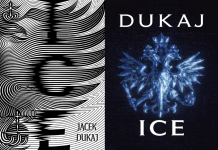





JACEK DUKAJ’S “ICE” successfully finished as a top-ten finalist for the 2026 Locus Award for Best Translated Novel.
Translated into English by Ursula Phillips and published by Head of Zeus Publisher (UK), the monumental 1,200-page Polish SF epic achieved significant critical acclaim throughout its award cycle.
Found in Translation Award: Ursula Phillips won the prestigious 2026 Found in Translation Award (FiTA) specifically for her monumental decade-long effort translating “Ice”‘s complex neologisms and linguistic structure.
EBRD Literature Prize: “ICE” was also shortlisted for the 2026 European Bank for Reconstruction and Development (EBRD) Literature Prize.
Jacek Dukaj’s „”Ice” is a monumental science fiction epic that transforms the Trans-Siberian railway into a philosophical and political crucible, where the frozen landscape mirrors a frozen history and logic.
In “Ice”, Jacek Dukaj crafts a dazzling alternate reality where the 20th century is arrested in a glacial stasis.
The novel opens on 14th July 1924, in a Warsaw buried under snow and Russian imperial rule.
Benedykt Gierosławski, a brilliant but dissolute mathematician, is summoned by the enigmatic Ministry of Winter and sent on a mission aboard the Trans-Siberian Express to locate his long-lost father.
This journey, however, is far more than a familial errand—it is a descent into a world reshaped by the alien aftermath of the Tunguska event.
The asteroid’s impact in 1908 unleashes the Ice, a mysterious substance that spreads across Siberia and beyond, bringing with it the Gleissen—silent entities that herald an eternal winter.
As temperatures plummet, agriculture collapses, cities swell with refugees, and history itself freezes.
The Tsar still reigns, the Belle Époque persists, and the Great War never erupts.
This frozen world is not merely climatic—it is metaphysical.
Dukaj introduces “zimnazo”, a transmuted form of iron with extraordinary properties, catalyzing a new industrial revolution rooted in “black physics.”
Logic itself succumbs to the cold: the fluid, many-valued logic of “Summer” gives way to the binary rigidity of “Winter,” where truth and falsehood admit no nuance.
Benedykt’s journey through this frozen empire is a kaleidoscope of intrigue.
He is ensnared in a power struggle between the liedniacy, who embrace the Ice’s permanence, and the ottiepelnicy, revolutionaries yearning for a thaw.
Along the way, he encounters disguised visionaries like Nikola Tesla, sects led by Rasputin worshiping the Ice, and thinkers like Fyodorov who dream of immortality.
The Siberian frontier becomes a crucible where shamanic mysticism, imperial politics, and radical science collide.
Dukaj’s narrative is not merely speculative—it is philosophical.
He reimagines science fiction as a vehicle for historical and metaphysical inquiry.
The Ice is not just a substance; it is a metaphor for ideological stasis, for the chilling of progress and plurality.
Through Benedykt’s eyes, we witness a world where the very laws of thought are rewritten, where the cold logic of Winter threatens to extinguish the warmth of human complexity.
“Ice” is a literary glacier—massive, intricate, and slow-moving, yet profoundly transformative. Its over 1,000 pages are dense with ideas, action, and atmosphere.
Critics have hailed it as a “sensational novel par excellence,” likening its narrative propulsion to Robert Ludlum, but with the intellectual heft of Borges or Lem.
Ultimately, Benedykt’s odyssey is a confrontation with the alien—both external and internal.
Will he embrace the Ice’s seductive clarity, or fight to restore the messy, mutable warmth of Summer?
In Dukaj’s frozen universe, this question is not just personal—it is civilizational.
“Ice” by Jacek Dukaj, translated by Ursula Phillips
Head of Zeus Publisher (UK):
“Publishing Jacek Dukaj’s door-stopping SF novel ‘Ice’ was a Herculean effort.
Dukaj considered the novel untranslatable, but after Head of Zeus acquired the text in 2017, they ran a competition with the Polish Book Institute to find the translator.
The inimitable Ursula Phillips translated the novel over seven years and the campaign for the long-awaited novel leaned into the story’s complexity, with a standout event with Dukaj at The British Library.“
“ICE” (Lód) is a Polish SF novel by the Polish science fiction writer Jacek Dukaj, published in Poland in 2007 by Wydawnictwo Literackie.
The novel mixes alternate history with science fiction elements, in particular, with alternative physics and logic.
It won the Janusz A. Zajdel Award, European Union Prize for Literature, and Kościelski Award.
“ICE” was shortlisted for the 2026 EBRD Literature Prize and The British Book Awards 2026.
In 2017 the novel was translated to Russian and Bulgarian, in 2018 the novel was translated to Ukrainian.
The Czech translation of the novel was released in 2021 and won the translation category of Magnesia Litera award the following year.

