








Agustín Fernández Mallo: the physicist‑poet of fragmentation, the visionary who turns the chaos of our hyperlinked world into electrifying literature that pulses with intelligence, audacity, and radical beauty.
There are books that behave like detonations—slow explosions that keep rumbling through the skull long after the covers close.
Agustín Fernández Mallo’s “The Book of All Loves” (El libro de todos los amores) is one of those rare devices: a quiet apocalypse disguised as a love story, a distillation of the world’s noise into a single, trembling frequency.
Reading it feels like walking through a city after the sirens have stopped, when the dust still floats in the air and every step crunches on the remnants of something that used to be called civilization. And yet, in the middle of that ruin, two unnamed figures hold on to each other as if their bodies were the last surviving language.
Agustín Fernández Mallo has always written like a physicist who escaped the lab with stolen instruments—oscilloscopes, fractal diagrams, half-burned notebooks—and decided to measure the world through literature instead.
His prose is a kind of experimental physics of the soul: data points scattered across continents, fragments of pop culture, philosophical shards, comic-book detritus, and the hum of deep-sea cables braided into a single, shimmering rhizome.
He is the cartographer of the globalized psyche, the chronicler of the spectral self that flickers between screens, airports, and memories.
In “The Book of All Loves“, he pushes this cartography into a new territory: the emotional geology of a world that has already ended. Not in flames, not in divine judgment, but in the slow erosion of meaning.
The apocalypse, he insists, is a fiction—one of humanity’s oldest prostheses, a myth we rehearse to soothe the terror of our own incompleteness. What remains after we discard the fantasy of annihilation is something stranger: a world that continues, stubbornly, absurdly, beautifully, and two people who cling to each other as if love were the last functioning technology.
This is where Agustín Fernández Mallo becomes unexpectedly tender.
Amid the ruins, love is not salvation, not redemption, not a collective utopia. It is a private ember, a micro-resistance against entropy. A prosthesis for a lack that never existed. A fiction that keeps us human.
And yet, Agustín Fernández Mallo’s tenderness is never sentimental. It is wired into the same circuitry that powers his Nocilla Trilogy, those kaleidoscopic novels that read like the inside of the internet dreaming.
His characters drift like particles in a collider: Che Guevara brushing shoulders with airport castaways, scientists sharing space with sex workers, comic-book heroes wandering through deserts of data.
The effect is not chaos but recognition.
This is our world, he says. This is how we live now—fragmented, overloaded, depersonalized, ghostlike. Literature must fracture itself to remain true.
In this sense, Agustín Fernández Mallo’s work vibrates on the same frequency as Benjamin Labatut, another writer who treats reality as a volatile substance.
Benjamin Labatut writes like a man chasing the radioactive core of human knowledge, following the trail of scientists who cracked open the universe and found madness staring back. His books are feverish autopsies of genius, chronicles of the moment when discovery becomes delirium.
But where Benjamin Labatut descends into the abyss of scientific obsession, Agustín Fernández Mallo maps the surface of the world as a living network. Labatut’s prose is vertical—plunging downward, drilling into the psychological bedrock of invention.
Agustín Fernández Mallo’s is horizontal—branching, proliferating, spreading like roots across continents. Benjamin Labatut writes about the terror of knowing too much; Mallo writes about the impossibility of knowing enough.
Benjamin Labatut’s universe is a dark laboratory; Agustín Fernández Mallo’s is an illuminated feed.
Both are obsessed with truth, but they approach it from opposite angles.
Benjamin Labatut seeks truth in the cracks of human reason, in the moment when the mind breaks under its own brilliance.
Agustín Fernández Mallo seeks truth in the fragments of daily life, in the debris of culture, in the flicker of a screen at 3 a.m.
Both reject the idea that literature is merely subjective confession.
Both treat fiction as an epistemic instrument.
Both believe that reality is too strange to be captured by realism.
Yet Agustín Fernández Mallo alone insists that the apocalypse is a myth.
Benjamin Labatut’s worlds tremble on the edge of catastrophe;
Agustín Fernández Mallo’s worlds have already survived it.
Benjamin Labatut writes about the danger of knowledge;
Agustín Fernández Mallo writes about the necessity of fiction.
Benjamin Labatut’s characters are haunted by the void;
Agustín Fernández Mallo’s characters invent prostheses to fill it.
In „The Book of All Loves”, this difference becomes luminous.
Agustín Fernández Mallo’s protagonists move through a landscape that feels both ancient and futuristic, a world where the ruins are metaphors and the metaphors are ruins.
They love each other not because love will save humanity, but because love is the only thing that makes the world bearable. It is a small, stubborn flame against the cold machinery of fear.
And in that flame, Agustín Fernández Mallo finds his answer to the question of collective redemption: there is nothing to redeem.
Nothing to save. The apocalypse is a story we tell ourselves.
The world continues.
We continue. We invent art, politics, science, literature—prostheses for a lack that never existed.
This is the strange, exhilarating beauty of Agustín Fernández Mallo’s work: it insists that fragmentation is not failure but form.
That chaos is not collapse but connection.
That love is not utopia but persistence.
That literature, like physics, can reveal the truth—if only we dare to break it into pieces.
In the end, Agustín Fernández Mallo and Benjamin Labatut stand like two beacons on opposite shores of the same storm.
One illuminates the abyss; the other illuminates the network.
One writes about the terror of brilliance; the other writes about the brilliance of terror.
Together, they form a new constellation in contemporary literature—a double star burning through the fog of our fractured age.
Agustín Fernández Mallo was born in La Coruña (Spain) in 1967, and is a qualified physicist.
He is considered one of the main regenerators of narrative in Spanish in recent years.
Prominent in his work is his interest in the reinterpretation, appropriation and interconnection of apparently distant concepts.
He is the author of Proyecto Nocilla (Alfaguara, 2006-2012), which consists of the novels Nocilla Dream (Candanya), Nocilla Experience (Alfaguara) and Nocilla Lab (Alfaguara), awarded different prizes and translated into several languages, the author of the book of short stories El hacedor (de Borges), Remake (Alfaguara, 2011), of the novel Limbo (Alfaguara, 2014).
For the novel Trilogía de la guerra (Seix Barral, 2018; The Things We’ve Seen), he won the Biblioteca Breve award.
In 2000 he formulated a self-termed theory of ‘post-poetry’ which explores connections between art and science. His essay Postpoesía: hacia un nuevo paradigma was shortlisted for the Anagrama Essay Prize in 2009.
His Nocilla Trilogy, published between 2006 and 2009, brought about an important shift in contemporary Spanish writing and paved the way for the birth of a new generation of authors, known as the ‘Nocilla Generation’.
In 2018 his long essay Teoría general de la basura (cultura, apropiación, complejidad) / General Theory of Rubbish (on the evolution of culture, now that we are living in the post era, where artists and thinkers are recycling the remnants of a society that has come undone), was published by Galaxia Gutenberg.
In 2022, he was awarded the prestigious Eugenio Trías Essay Prize for La forma de la multitud.
Fiction
The Nocilla Trilogy: Nocilla Dream, 2006; Nocilla Experience, 2008; Nocilla Lab, 2009
Limbo, Alfaguara, 2014
The Things We’ve Seen, 2021 (Trilogía de la guerra)
The Book of All Loves (El libro de todos los amores, 2024)
El hacedor (de Borges) / The Maker (of Borges) Remake)
Essays
Postpoesía. Hacia un nuevo paradigma, 2009 (Post-Poetry: Toward a New Paradigm)
Teoría general de la basura (cultura, apropiación, complejidad), 2018/ General Theory of Rubbish (Culture, Appropriation, Complexity)
La forma de la multitud, 2022 / The Shape of the Multitude (Eugenio Trías Essay Prize)
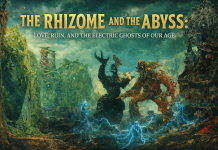
The banner is created and displayed solely as an artistic homage to European Surrealism. Its purpose is strictly illustrative, educational, and non-commercial. It serves to visually articulate a conceptual theme and does not constitute advertising, endorsement, or commercial exploitation of any proprietary artistic assets.
The use of these artistic elements is protected under the fundamental principles of a democratic society, specifically the right to freedom of expression, freedom of the arts, and the promotion of cultural discourse. In accordance with domestic and international copyright frameworks—including provisions for fair use, fair dealing, and quotation for transformative, critical, or illustrative purposes—the replication or adaptation of these stylistic motifs is executed strictly to demonstrate an abstract concept, rather than to infringe upon the commercial rights of any copyright holders.
No financial profit, commercial gain, or corporate advantage is derived from the publication of this banner. All intellectual property rights, trademarks, and original copyrights belonging to the respective artists, estates, or institutions of the European Surrealist movement are fully acknowledged and remain the exclusive property of their rightful owners.
This display is provided “as is” for informational and cultural enrichment. The publisher disclaims any liability arising from misinterpretation of the visual content or claims of unauthorized commercialization, as the transformative nature of this tribute strictly aligns with public interest and educational exemptions within intellectual property law.

