
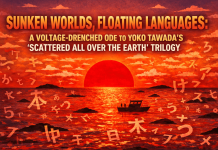


Yoko Tawada’s trilogy doesn’t simply imagine the future — it dissolves it, ferments it, lets it bubble and hiss until the very idea of “nation” melts like ice under a feverish sun.
These books don’t march forward; they drift, swirl, scatter, just like the people inside them. Reading them feels like hitchhiking across a continent that no longer remembers its own borders, guided by a narrator who speaks in a language that didn’t exist yesterday and might mutate again by morning.
Yoko Tawada didn’t wander into science fiction by accident — she arrived there the way a fault line arrives at an earthquake, with pressure building for decades in her obsessions with language, identity, and the fragile membranes separating humans from the worlds they inhabit. The trilogy is not a genre detour; it is the inevitable evolution of a writer who has always treated reality as something porous, unstable, and linguistically negotiable.
Yoko Tawada writes SF because the present has already become speculative. Climate collapse, vanishing nations, linguistic extinction — these are not futuristic anxieties but contemporary conditions. By shifting into a near‑future mode, she isn’t escaping realism; she’s intensifying it, stripping away the illusion that the world still obeys the old rules. The disappearance of Japan is not a metaphor — it’s a narrative pressure cooker that forces her characters to reinvent themselves at the molecular level of language.
And this is why the plot moves the way it does: not in straight lines, but in wandering, border‑crossing spirals. Tawada refuses the authoritarian clarity of traditional dystopia. Instead, she lets her characters drift, collide, misunderstand one another, and build fragile alliances out of mispronunciations and half‑translated desires. The structure mirrors the condition of diaspora — nonlinear, improvised, full of detours and accidental revelations.
Her characters are not heroes; they are linguistic migrants, each carrying a fractured worldview like a cracked compass. Hiruko invents a language because the world has erased the one she was born into. Knut chases accents the way other people chase ghosts. Susanoo loses his voice entirely, as if the future were demanding a new form of communication beyond speech.
Tawada guides them this way because she is less interested in plot than in the strange alchemy that happens when identity is forced to mutate. She wants to see what remains of a person when their homeland sinks, their language dissolves, and their cultural coordinates scatter like ash in the wind.
In the end, she writes SF for the same reason she writes bilingual fiction: to expose the cracks in the world we think we understand, and to show that in those cracks — in the mishearings, the mistranslations, the drifting — something radically new can grow.
At the center of this luminous chaos stands Hiruko, a climate refugee whose homeland has literally slipped beneath the waves. She carries no flag, no anthem, no coordinates — only a homemade language stitched together from the scraps of Scandinavia. It’s a tongue born of necessity, a survival mechanism, a linguistic raft. And as she wanders across Europe, she gathers around her a constellation of misfits, each one vibrating with their own strange frequency. Together they form a kind of accidental family, a roaming chorus of accents, desires, and half‑remembered identities.
The trilogy moves with the delirious energy of a world that has lost its center of gravity.
One moment you’re in Denmark, the next in a sushi‑less Japan that no longer exists, then in a clinic where voices vanish like faulty radio signals.
Yoko Tawada’s characters don’t simply cross borders — they dissolve them, turning every encounter into a linguistic experiment, every conversation into a small act of reinvention.
What makes these novels so intoxicating is their refusal to bow to dystopian gloom. Yes, the world is fractured. Yes, nations have drowned, languages have splintered, and identities have become migratory birds.
But YokoTawada writes with a warmth that feels almost rebellious. Her apocalypse is gentle, absurd, tender — a place where friendship becomes the last surviving technology.
By the time the trilogy reaches its final movement, the journey feels less like a search for a lost homeland and more like a pilgrimage toward a new way of being human.
Yoko Tawada’s great trick is to show that the future won’t be built on steel or circuitry, but on the fragile, shimmering threads of language — improvised, shared, misheard, reinvented.
“The Scattered All Over the Earth” is not just a story; it’s a migration of voices, a drifting archipelago of identities, a reminder that in a world where everything is sinking, the only thing that keeps us afloat is the strange, stubborn desire to understand one another.
Yōko Tawada (born March 23, 1960) is a Japanese writer currently living in Berlin, Germany. She writes in both Japanese and German.
She is a former writer-in-residence at MIT and Stanford University.
Yoko Tawada has won numerous literary awards, including the Akutagawa Prize, the Tanizaki Prize, the Noma Literary Prize, the Izumi Kyōka Prize for Literature, the Gunzo Prize for New Writers, the Goethe Medal, the Kleist Prize, and a National Book Award.
In 2005, Tawada won the prestigious Goethe Medal from the Goethe-Institut for meritorious contributions to German culture by a non-German.
“The Scattered All Over the Earth” SF trilogy (originally titled „Chikyū ni chiribamerarete”) is a celebrated, polyglottal, and “cheerfully dystopian” series.
Scattered All Over the Earth (2018):
Introduces Hiruko, who teaches immigrant children in Denmark using a “homemade” language called Panska (Pan-Scandinavian). She meets Knut, a Danish linguistics graduate student, and forms a diverse group of friends to cross borders in search of other survivors.
Suggested in the Stars (2024):
Carries on the adventures of the eccentric travel group as they track down Susanoo, a sushi chef from Hiruko’s vanished nation. When they find him, he has lost his voice, prompting a chaotic trip to Copenhagen to see a specialized speech-loss doctor.
Archipelago of the Sun (2025):
Concludes the pan-European romp and the overarching search for the lost “land of sushi”. It brings the group’s journey to a profound close without relying on neat, conventional resolutions.Key Literary ThemesLinguistic Playfulness: Characters drift through multiple real and fictional tongues, exploring how identity transforms depending on the language we use to communicate.Quiet Dystopia: Unlike violent post-apocalyptic tales, Tawada builds a world facing climate disaster and border absurdities with immense gentleness, warmth, and friendship.
Translated into English by Margaret Mitsutani, the series follows a climate refugee named Hiruko on a pan-European journey to find anyone who still speaks her native language after her homeland, Japan, completely vanishes into the sea.
Challenging boundaries is further explored in “The Last Children of Tokyo” (Kentoshi, 2014), a near-future dystopian story of a great-grandfather who grows stronger while his great-grandson grows weaker, was published in Japan, in which the catastrophe against which the novel is set “reconnects humans with non-human agencies, questioning the very meaning of the exclusive concept of “human”.
By imagining children as going back to an earlier stage rather than ever improving – a meandering that is reflected in the novel’s non-linear, associative narration – Yoko Tawada terminates their ties to futurity, and with it the capitalist myth of continuous progress.”
An English version, translated by Margaret Mitsutani, was published in the US by New Directions Publishing in 2018 under the title “The Emissary” and as “The Last Children of Tokyo” by Portobello Books/Granta Books in the UK.

