





“If you found out we weren’t alone, if someone showed you, proved it to you, would that frighten you?
People have a right to know the truth! Full disclosure, to the whole world, all at once!”
All Will Be Disclosed!
The truth belongs to 8 billion people. We are coming close to … Disclosure Day!
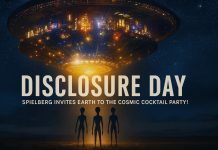
Steven Spielberg is back, and this time he’s not just asking us to phone home—he’s throwing open the doors to the galaxy and demanding we RSVP.
“Disclosure Day”, his latest SF extravaganza, takes the UFO genre and spins it into a dazzling, star-studded spectacle where humanity finally gets the memo: we’re not alone, and the neighbors are dropping by unannounced.
Written by David Koepp, long-time Spielberg collaborator and the mind behind “Jurassic Park”, the film expands from a story conceived by Spielberg himself, weaving together awe, fear, and the profound question of what it means to share the universe.
The cast is a constellation in itself—Emily Blunt, Josh O’Connor, Colin Firth, Colman Domingo, Eve Hewson, and Wyatt Russell—each grappling with the biggest “surprise party” in history.
Their characters are thrust into the seismic revelation that we are not alone, each voice echoing the urgency of disclosure.
O’Connor’s character insists, “People have a right to know the truth, it belongs to 8 billion people,” while Elizabeth Marvel delivers the trailer’s mic-drop: “Why would He make such a vast universe yet save it only for us?”
These words frame the film’s central tension—between secrecy and revelation, fear and hope, isolation and belonging.
For Spielberg, “Disclosure Day” marks a return to the terrain of the unknown, revisiting the alien encounters that defined earlier milestones like “Close Encounters of the Third Kind”, “E.T.”, and “War of the Worlds”.
Yet this time, the tone is more urgent, more emotional, and deeply human.
Translation: the universe is way too big for just one species hogging the snacks.
Spielberg, fresh off “The Fabelmans”, returns to his favorite playground of awe and aliens, echoing the wonder of “Close Encounters” and the heart of “E.T.”, but with a sharper, more urgent edge.
Actor Colman Domingo confessed the script made him cry, calling it “the most beautiful film about our humanity.”
And if Spielberg can make hardened actors bawl, imagine what he’ll do to audiences armed only with popcorn.
The timing couldn’t be juicier.
The film’s marketing campaign rides the wave of “The Age of Disclosure”, a record-breaking documentary alleging government cover-ups of alien life.
Billboards are already lighting up Times Square, and the trailer is set to beam out before the latest “Avatar”.
In other words, Spielberg isn’t just releasing a movie—he’s staging a planetary announcement.
Spring-Summer 2026 will be crowded with cinematic heavyweights, but “Disclosure Day” promises to be the one that makes audiences look skyward, laugh nervously, and wonder if the popcorn bucket is big enough for two species.
Spielberg doesn’t just want us to believe—we’re already invited to the party. And the guest list? Universal.
Steven Spielberg’s “Disclosure Day” arrives as a cinematic event steeped in mystery, spectacle, and the director’s unmistakable touch.
The first trailer has unveiled a glimpse into a world where humanity confronts the unimaginable: the undeniable presence of extraterrestrial life.
“I think it is only a matter of time before a sitting US president steps to the podium, and tells the world that we are not the only intelligent life in the universe.”
Steven Spielberg’s “Disclosure Day”, arriving on 12 June 2026, feels less like a simple return to extraterrestrial wonder and more like a reckoning with nearly fifty years of cultural anxiety.
It stands in deliberate conversation with “Close Encounters of the Third Kind”, not as a sequel, but as a spiritual continuation of the questions that film first dared to ask: What if the government knows more than it admits? And what happens when ordinary people collide with extraordinary truths?
The new film unfolds in a world already saturated with suspicion, where official statements are met with raised eyebrows and every grainy light in the sky becomes a potential revelation.
Spielberg leans into that atmosphere, crafting a story that blends the awe of first contact with the paranoia of a post‑truth era.
The echoes of “Close Encounters” are unmistakable—friendly visitors from elsewhere, the sense of cosmic possibility—but “Disclosure Day” shifts the focus from wonder to the machinery of secrecy that has grown ever more elaborate since 1977.
At the center of the story is Daniel, played by Josh O’Connor, a soft‑spoken technician who never intended to become a whistleblower.
Employed by Wardex, a shadowy agency operating just outside the boundaries of legality, he stumbles onto decades of buried evidence: encounters, recordings, biological samples, and testimonies that were never meant to see daylight.
His decision to expose the truth turns him into a fugitive, hunted by the very institution that once relied on his quiet competence.
Emily Blunt’s character becomes his reluctant ally, drawn into the chase as the scale of the cover‑up becomes impossible to ignore.
Spielberg frames their flight with the tension of the great 1970s conspiracy thrillers—”Three Days of the Condor” is an obvious touchstone—where a single piece of knowledge can make an ordinary person dangerously important.
Yet he also infuses the film with the emotional undercurrents that have always defined his work: fractured families, the longing for connection, and the sense that the universe might be more welcoming than the institutions meant to protect us.
What gives “Disclosure Day” its particular charge is the real‑world backdrop against which it arrives.
The Pentagon’s halting releases of UAP (Unidentified Anomalous Phenomena, the updated term for UFOs) reports, Congressional hearings that raise more questions than they answer, and decades of contradictory statements have created a cultural moment primed for a story like this.
Spielberg doesn’t claim to offer answers, but he captures the restless hunger for them—the feeling that something is being withheld, and that the truth, whatever it is, has been hovering just beyond reach.
The film’s emotional core crystallizes in the line delivered by Colman Domingo’s character, Hugo, another Wardex insider who has lost patience with the endless obfuscation: “This seventy‑nine‑year terror campaign of lies and cover‑up has to end.”
It’s a sentiment that resonates far beyond the screen, tapping into a collective frustration with institutions that seem increasingly opaque.
In the end, “Disclosure Day” is less about aliens than about the human need to understand our place in the cosmos, and the forces—bureaucratic, political, psychological—that stand in the way of that understanding.
Spielberg revisits the territory he helped define, but with the perspective of a filmmaker who has watched the world grow more skeptical, more fragmented, and more desperate for clarity.
The result is a film that feels both nostalgic and urgently contemporary, a story about visitors from the stars and the secrets we keep from ourselves
“Disclosure Day” is an upcoming American science fiction film produced and directed by Steven Spielberg from a screenplay by David Koepp based on a story by Spielberg. The film stars Emily Blunt, Josh O’Connor, Colin Firth, Eve Hewson, and Colman Domingo.
“Disclosure Day” is scheduled to be released in the United States by Universal Pictures on June 12, 2026.
“The Age of Disclosure”: An explosive documentary that reveals an 80-year global cover-up of non-human intelligent life and a secret war among major nations to reverse-engineer advanced technology of non-human origin.
Directed and produced by Dan Farah, the unprecedented and revelatory documentary film–featuring 34 senior members of the U.S. Government, military, and intelligence community–reveals an 80 year cover-up of the existence of non-human intelligent life and a secret war amongst major nations to reverse engineer technology of non-human origin.
The film exposes the profound impact the situation has on the future of humanity, while providing a look behind-the-scenes with those at the forefront of the bi-partisan disclosure effort.
.

