





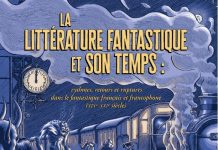


“Fantastic Literature and Its Time — Rhythms, Returns, and Ruptures in French and Francophone Fantastic Literature, 19th–21st Centuries” (La littérature fantastique et son temps : rythmes, retours et ruptures dans le fantastique français et francophone, XIXe-XXIe s.), Sorbonne University, Paris, 4-6 June 2026
Paris is vibrating this week, and not because of traffic, protests, or the usual existential despair.
No—there’s a different electricity in the air, something older, stranger, more deliciously unhinged.
The Sorbonne has thrown open its doors to “La Littérature fantastique et son temps” (Fantastic Literature and Its Time), a three‑day intellectual séance dedicated to the rhythms, ruptures, and returns of the French and Francophone fantastique from the nineteenth century to the twenty‑first.
It feels less like a colloquium and more like a controlled detonation of academic respectability.
Professors, researchers, and the occasional wide‑eyed graduate student wander the halls of Pierre‑et‑Marie‑Curie campus as if expecting a ghost to slip out of a footnote.
And honestly, who could blame them.
The fantastique (la littérature fantastique, Fantastische Literatur, literatura fantástica, letteratura fantastica, fantastisk litteratur, literatura fantastyczna, fantastická literatura, etc.) has always been a genre that refuses to sit quietly in the corner—it scratches at the wallpaper, whispers behind your shoulder, rearranges the furniture of reality when you’re not looking.
The fantastique asserted itself as a legitimate narrative register precisely because the supernatural is never mere ornamentation; it becomes a metaphorical instrument for probing the human condition. The fantastic does not offer an escape from the world—it turns the world inside out, forcing us to question the solidity of reality, the fragility of memory, the elasticity of time, and the instability of identity.
Its philosophical ambition lies in this relentless interrogation and Psychological complexity is at its core.
The fantastic unfolds not in haunted castles but in haunted minds: characters slip into madness, fracture into doubles, or confront the abyss of their own existence. The uncanny becomes a mirror in which consciousness sees itself distorted, magnified, or undone.
Stylistically, the fantastic cultivates refinement through ambiguity. Its narratives resist closure, leaving shadows where one expects clarity, and fissures where one expects certainty. This deliberate indeterminacy—this art of hesitation—has secured the fantastic a place within the canon, earning the respect of critics and scholars across the nineteenth and twentieth centuries. It is a literature that thrives not on answers, but on the exquisite tension of the unresolved.
Inside the lecture rooms, the air crackles with arguments about temporal fractures, creole wonder, African magic, unconscious eruptions, and the impossible dance between the real and the supernatural.
The French literature fantastique has never accepted the Anglo-saxon binary of “real versus unreal,” because in so many Francophone cultures the supernatural is not an intrusion—it is the wallpaper, the floorboards, the air itself. Scholars dissect how time bends, stutters, collapses, or explodes in these narratives, how characters slip sideways into other logics, other cosmologies, other ways of being.
It is exhilarating. It is chaotic. It is gloriously alive.
And yet, hovering like a smug, overfed specter in the background, there is the AngloSFere—the vast English‑language publishing machine that pretends none of this exists.
For decades, it has flattened the entire global field of the imaginary into a single, bloated umbrella term: „fantasy”.
A word so vague it can mean Jorge Luis Borges or a mass‑produced moronic dragon romance churned out by an algorithm.
A word that erases distinctions, histories, aesthetics, and entire literary traditions with the casual arrogance of an empire that believes it invented everything from the fantastic to science fiction.
The AngloSFere does not see the French literature fantastique or any other Euro-continental fantastique literatures.
It does not see the Latin American “real maravilloso”.
It does not see the South-Eastern European uncanny, the African magical, the Caribbean spectral.
It sees only itself, reflected endlessly in its own funhouse mirror.
Meanwhile, at the Sorbonne University, scholars are busy mapping the fault lines of a genre that has been thriving for centuries outside the Anglophone gaze.
They trace the ruptures that force characters to renegotiate their place in space‑time, the anachronisms that warp narrative logic, the stases that freeze reality into something crystalline and terrifying.
They explore how the fantastique emerges not as a reaction to science, but as a continuation of cultural memory, ritual, and cosmology.
This colloquium is not merely an academic gathering.
It is an act of reclamation.
A declaration that the fantastique is not a subgenre, not a curiosity, not a footnote to Anglo‑American publishing trends.
It is a sovereign literary tradition with its own history, its own aesthetics, its own pulse.
As the sessions unfold—Les récits fantastiques francophones, La Magie dans le roman africain (Magic in the African Novel), Démons et Merveilles (Demons and Wonders)—you can feel the walls of the Sorbonne expanding, as if making room for all the ghosts, spirits, monsters, and temporal anomalies that have been waiting centuries for this recognition.
The fantastique is not a shadow of fantasy.
It is not a derivative.
It is not an appendix to Tolkien.
It is a continent of its own, and the Sorbonne has just lit it up like a constellation.
Fantastic literature was invented in Europe and has a long history, for example Lucuis Apuleius’s “The Golden Donkey” (Asinus aureus, also known as Metamorphoses, 2nd century AD). One of its forerunners is Jacques Cazotte, whose short novel “Le Diable amoureux” (The Devil in Love, 1772) is considered the first fantastic narrative in the French language.
Another major Enlightenment figure associated with the fantastic is the Polish writer Jan Potocki, whose “Le Manuscrit trouvé à Saragosse” (The Manuscript Found in Saragossa) was likewise written in 1794 in French.
And it was in Germany, at the beginning of the nineteenth century, that fantastic literature in the strict sense was born, with Adelbert von Chamisso (Peter Schlemihl), followed by Achim von Arnim and E.T.A. Hoffmann (Fantasiestücke in Callot’s Manner, Night Tales)
Somewhere in the AngloSFere, a marketing department will continue to pretend that “fantasy” is a universal term, and in the Anglo‑Saxon world, the fantastic literature is not regarded as a genre in its own right but rather as a subcategory of low fantasy.
But here, in Paris, scholars know better.
They are charting the real map of the imaginary—one rupture, one return, one temporal dislocation at a time.
And the Euro-continental literature fantastique, long underestimated, long mislabeled, long ignored, is finally stepping into the light with a wicked smile, ready to haunt the world on its own terms.
The Sorbonne has staged something rare this week—an academic convocation that feels less like a conference and more like a Euro-continental uprising in the name of the fantastique.
For three days, some of the most respected scholars in Europe, Africa, and North America have converged in Paris to dissect the temporal machinery of French and Francophone fantastic literature, and the result is a kind of intellectual fever dream.
You can feel it in the corridors of the Pierre‑et‑Marie‑Curie campus: the hum of ideas, the shuffle of programs, the quiet thrill of knowing you’re witnessing a tradition that has shaped European imagination for two centuries being examined with surgical precision and unrestrained passion.
The roster alone reads like a declaration of prestige.
Nathalie Dufayet opens with a chronocritical theory of fantastic time; Noëlle Benhamou unravels the temporal paradoxes of Erckmann‑Chatrian; Marie‑Cécile Cadars traces the fractures between sacred and real time in Huysmans; Naïma Rachdi brings the Moroccan fantastique into the conversation with Bouanani and Rabbaj. Later, Piotr Kaczka arrives from the University of Silesia to explore nineteenth‑century memory chambers, while Morgane Leray probes the mystical and pathological dimensions of Rachilde. Kévin Petroni dissects trauma in Pierre Jourde; Silvia Suardi confronts the temporal anxieties of Maupassant and Balzac.
And that’s only the first day.
The second day expands the map even further. Colline Charli from Tübingen examines phantasmagoric temporalities; Judith Trouilleux‑Leca revisits Dumas; Gilles Bouchard‑Arus navigates the shockwaves of time in Châteaureynaud. In the afternoon, the spirits arrive—Diakaridia Koné from Côte d’Ivoire evokes the living dead of Malinké culture; Francesca Paraboschi explores temporal imprisonment in Stanley Péan; Chloé Berr from the University of Virginia dissects paradox in Gautier; Floriana Ripa confronts the returning horror in Thérèse Raquin; Laëtitia Bertrand traces the nocturnal modernity of early Musset.
By the third day, the colloquium has become a full‑scale cartography of the fantastique. Annabelle Carissimo examines supernatural time in the graphic novels of Jean‑Claude Servais; Ariane Gélinas and Frédérick Durand bring the haunting persistence of Quebec’s past to the stage; Marie‑France Bereni‑Canazzi resurrects Corsican revenants and the Mazzeru; Ghizlane Lemnouer closes with a meditation on postcolonial memory and the wandering poetics of Chamoiseau.
What emerges from this gathering is unmistakable: the fantastique is not a minor genre, not a curiosity, not a footnote to realism. It is a major literary force in continental Europe, studied with the same rigor and reverence afforded to any canonical tradition.
The presence of scholars from France, Belgium, Italy, Germany, Poland, Morocco, Côte d’Ivoire, Canada, the United States, and beyond is proof enough. The fantastique is a living, evolving, intellectually formidable field—one that refuses to be flattened by the anglocentric umbrella of “fantasy,” a term that often lumps masterpieces and mass‑produced pulp into the same shapeless category.
Here, at the Sorbonne, the fantastique stands in its full complexity: historical, psychological, postcolonial, creole, African, Quebecois, Mediterranean, spectral, temporal, and defiantly untranslatable into the simplistic frameworks of the AngloSFera. It is a literature that bends time, fractures logic, and challenges the very foundations of narrative reality.
And for three days in June 2026, it has taken its rightful place at the center of European intellectual life—radiant, unsettling, and utterly indispensable.

