






Featured Guests include Ted Chiang (United States), Chuck Palahniuk (United States),Paolo Bacigalupi (United States), Alastair Reynolds (United Kingdom),Ian McDonald (United Kingdom), Joe Abercrombie (United Kingdom), John Gwynne (United Kingdom), Jo Walton (United Kingdom/Canada), Becky Chambers (United States), T. Kingfisher (United States), Samantha Shannon (United Kingdom), Anna Smith Spark (United Kingdom), Kaaron Warren (Australia), Aliya Whiteley (United Kingdom), Josh Malerman (United States), Grady Hendrix (United States), Joe Hill (United States), Chris Claremont (United States), Larry Hama (United States), Peter Tieryas (United States), Christopher Buehlman (United States), Alix E. Harrow (United States), Sangu Mandanna (United Kingdom), C. S. Pacat (Australia), Drew Karpyshyn (Canada), Ryan Cahill (Ireland), Francesco Nepitello (Italy), Héctor Peña Manterola (Mexico), Katherine Vega (Spain), Miriam Bonastre (Spain), Manuel Moyano (Spain), Ángel Luis Sucasas (Spain), Luis Corte Real (Portugal), David Pascual (Spain), Nadia Bulkin (Indonesia/United States), Laura Fernández (Spain), J. V. Gachs (Spain), C. A. Todorova (Bulgaria), Brigid Kemmerer (United States), Eduardo Infante (Spain), David Uclés (Spain), Maeva Nieto (Spain), Jennifer Yen (United States), Raúl Quinto (Spain), Nerea Llanes (Spain), Andrea Serra (Spain), Elaine Vilar Madruga (Cuba), Annaliese Avery (United Kingdom), Jakub Szamałek (Poland), F. M. Wylde (United Kingdom), Miyuki Kurame (Japan), Choi Jin‑Young (South Korea), Gabriela Damián (Mexico), Paco Plaza (Spain), Renee Witterstaetter (United States), Rob Savage (United Kingdom), Gunilla Jonsson (Sweden) and Michael Petersen (Sweden), César Mallorquí (Spain), Carlos Sisí (Spain), Susanna Isern (Spain), María Fernanda Ampuero (Ecuador), Petra Reis (Spain), Victoria Álvarez (Spain), and Sofía Rhei (Spain) — a constellation of voices whose diversity and renown confirm Celsius 232 as the most luminous summer gathering of speculative imagination in Europe.
Each July, the quiet Asturian town of Avilés ignites with the fever of imagination.
In the heart of Asturias, Spain, where the ocean meets the mountains in a wild symphony of landscapes, Avilés transforms for five magical days each summer into the world capital of literary dreams.
Here, for fourteen years running, a fire has been kindled—not one that burns books, but one that elevates them to living art. Celsius 232—a name that playfully evokes Bradbury’s dystopia, yet in reality celebrates the written word, ideas, and community.
It is not just Europe’s most important summer festival of science fiction, fantasy, and horror; it is a cultural phenomenon that has turned passion into a mass movement, a wave that has swept across Spain and beyond.
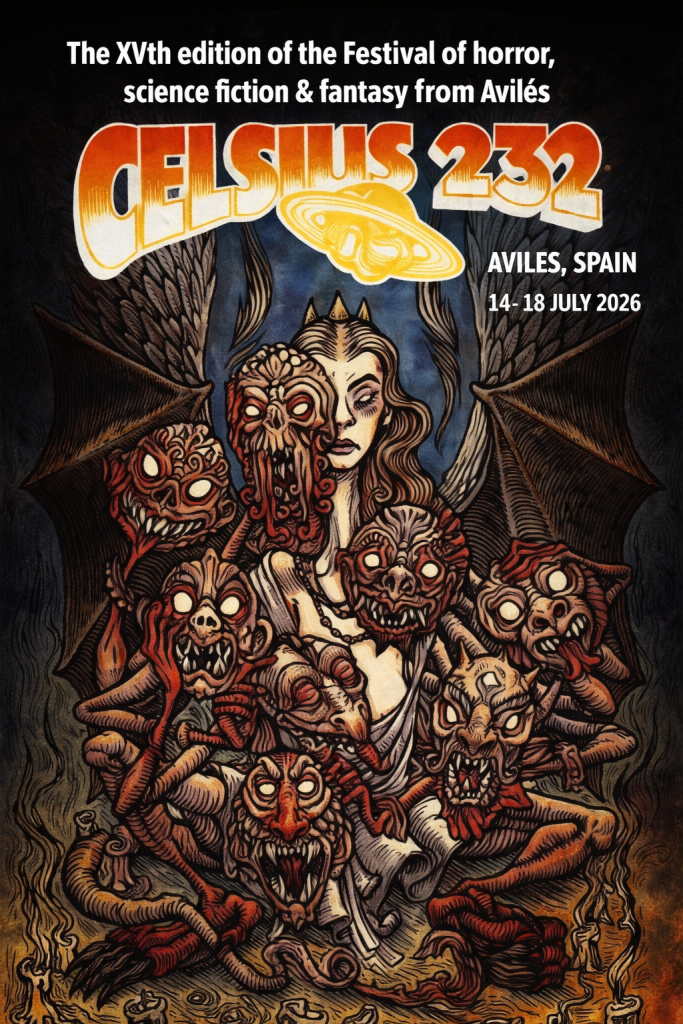
What is Celsius 232, really?
It is absolute freedom.
No tickets, no membership lists, no barriers.
Every door is open, every conversation possible.
It is a space where fans, writers, artists, and dreamers gather under the same sky, speaking the universal languages of imagination.
Even English, with Spanish interpretation, becomes a bridge between cultures, proof that literature knows no borders.
But above all, Celsius 232 is the atmosphere—that indescribable yet palpable energy: wide smiles, animated discussions, an enthusiasm that flows like a river in full flood.
Celsius 232—named with sly reverence for Bradbury’s „Fahrenheit 451”—has become, after fourteen editions, the beating summer heart of European speculative fiction.
What began as a local celebration of science fiction, fantasy, and horror has evolved into a continental phenomenon, rivaling France’s autumnal Utopiales Festival in scope and prestige.
The Spanish organizers have achieved what few cultural dreamers manage: they have turned a niche festival into a mass event, a carnival of ideas and stories that now draws more than 40,000 participants each year.
Streets, cafés, and plazas overflow with readers, fans, writers, and artists, all speaking the shared language of wonder.
Each edition of the festival welcomes an impressive average of 150 to 200 national and international authors, transforming Avilés into a vibrant hub of literary talent. The program is just as ambitious, featuring between 160 and over 220 scheduled activities—ranging from thought-provoking panels and hands-on workshops to dazzling cosplay showcases—ensuring that every moment is filled with creativity, discussion, and celebration.
Celsius 232: The Flame That Ignites Europe’s Imagination
And what better proof of its success than the numbers?
Over 40,000 participants in 2025, a true human tide that turns the streets of Avilés into a carousel of ideas.
But numbers don’t tell the whole story.
The festival’s true pride lies in its guest list, a veritable galaxy of literary stars.
The guest list reads like an Oscar Awards‑night parade of the fantastic.
Names that have shaped the genre: Ted Chiang, master of reality-bending short stories; Paolo Bacigalupi, architect of dystopian worlds; Alastair Reynolds, Ian McDonald, Joe Abercrombie—giants of contemporary science fiction and fantasy. Joe Hill, heir to Stephen King, alongside Becky Chambers, T. Kingfisher, Samantha Shannon, Alix E. Harrow—a constellation of voices that have captivated readers across continents. And the list goes on: from Chris Claremont, legendary creator of Marvel universes, to Larry Hama, from Grady Hendrix, king of retro horror, to Josh Malerman, the mind behind the global phenomenon Bird Box, and dozens more from every corner of the planet.
But Celsius 232 is not just about literary superstars. It is also about discovering new talents, about authors from the most unexpected corners of the world bringing stories that challenge horizons. Gabriela Damián, the rising star of Latin American science fiction; Elaine Vilar Madruga, the voice of Cuban SF; Jakub Szamałek, ambassador of Polish literature; Miyuki Kurame and Choi Jin-Young, who bring Asian perspectives to the table.
And, of course, the strong presence of Ibero-American authors, from César Mallorquí to Victoria Álvarez, proving that genre literature needs no passport to conquer worlds.
There are no tickets, no membership lists, no velvet ropes—only open doors and open minds.
The festival’s spirit is democratic and exuberant, a celebration of fandom itself.
Conversations spill into the night, crossing languages and genres, as the air hums with the joy of shared obsession.
And because a true festival cannot exist without celebrating excellence, beyond its panels and readings, Celsius 232 also hosts the Kelvin 505 Awards, honoring the best science fiction, fantasy, and horror novels published in Spain.
Each year, the winners—authors like Rosa Montero, Anna Starobinets, Sofía Rhei, and Borja González—are celebrated in a ceremony that fuses literary prestige with the warmth of community.
In 2026, the trophies went to remarkable works: Rosa Montero’s Animales difíciles won Best Original Novel, while Anna Starobinets’ El vado de los zorros took Best Translated Novel.
Young readers were not forgotten: Sofía Rhei’s Camden Down was awarded Best Original YA Novel, and Suzanne Collins’ Amanecer en la cosecha won Best Translated YA Novel.
Even the covers were celebrated, with Borja González winning for his design of the Spanish edition of Adrian Tchaikovsky’s „Ogros” (Ogres).
In 2026, from Tuesday, July 14th to Saturday, July 18th, Avilés will once again become the capital of imagination—a place where dragons, starships, and ghosts walk freely among the living, and where Europe remembers that its truest unity lies not in politics, but in stories.
Celsius 232 is more than a festival.
It is a quiet revolution, a manifesto of creative freedom, proof that genre literature can be both popular and profound, local and universal.
It is the place where fans and authors meet as equals, where every story matters, where the flame of passion burns as fiercely as its name—232 degrees Celsius, the temperature at which paper burns, but also the temperature at which minds ignite.
2026 Premios Kelvin Winners
Winners have been announced for the 2026 Premios Kelvin 505 Awards, presented by the Celsius 232 festival and honoring the best science fiction, fantasy, and horror novels published in Spain.
WINNER: Animales difíciles de Rosa Montero; Impía de J. V. Gachs; U.N.I. (U.N.I., acronim fără traducere necesară) de Antonio Garber; Salitre y cenizas de Carlos Di Urarte; La luz en la niebla (The Light in the Fog) de Victoria Álvarez; Cuatro dormitorios con piscina (Four Bedrooms with a Pool) de Inés Galiano; Sangre Real (Royal Blood) de Marina Tena.
Mejor Novela Original (Best Original Novel)
WINNER: Animales difíciles (Difficult Animals), Rosa Montero (Seix Barral)
Impía (Impious), J.V. Gachs (Dolmen)
U.N.I., Antonio Garber (Menoscuarto)
Salitre y cenizas (Saltpeter and Ashes), Carlos Di Urarte (El transbordador)
Mejor Novela Traducida (Best Translated Novel)
WINNER: El vado de los zorros (Fox Fords), Anna Starobinets, tr. Viktoria Leftérova & Enrique Maldonado (Impedimenta)
Los diablos (The Devils), Joe Abercrombie, tr. Manu Viciano (Runas)
El reformatorio (The Reformatory), Tananarive Due, tr. María Pérez de San Román (La biblioteca de Carfax)
El diablo te lleva a casa (The Devil Takes You Home), Gabino Iglesias, tr. Miguel Sanz Jiménez (La biblioteca de Carfax)
Mejor Novela Juvenil Original (Best Original YA Novel)
WINNER: Camden Down, Sofía Rhei (Loqueleo)
La luz en la niebla (The Light in the Fog), Victoria Álvarez (Molino)
Cuatro dormitorios con piscina (Four Bedrooms with a Pool), Inés Galiano (Numak)
Sangre Real (Royal Blood), Marina Tena (Loqueleo)
Mejor Novela Juvenil Traducida (Best Translated YA Novel)
WINNER: Amanecer en la cosecha (Sunrise on the Reaping), Suzanne Collins, tr. Pilar Ramírez Tello (Molino)
El aliento del dragón (Breath of the Dragon), Fonda Lee & Sharon Lee, tr. Antonio Rivas (Hidra)
Ahora todo es mejor (All Better Now), Neal Shusterman, tr. Laura Feijóo Sánchez (Nocturna)
Nuestros destinos infinitos (Our Infinite Fates), Laura Steven, tr. Esther Villardón Grande (Umbriel)
The winner of Mejor Portada Edición Española (Best Spanish Edition Cover) was Borja González for „Ogros” (Ogres) by Adrian Tchaikovsky (Dolmen).
Winners will be honored during the Celsius 232 festival, to be held July 14-18, 2026 in Avilés, Spain.
For more information, see the Kelvin 505 website:
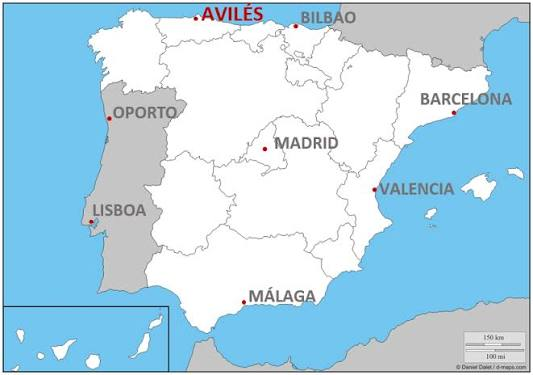
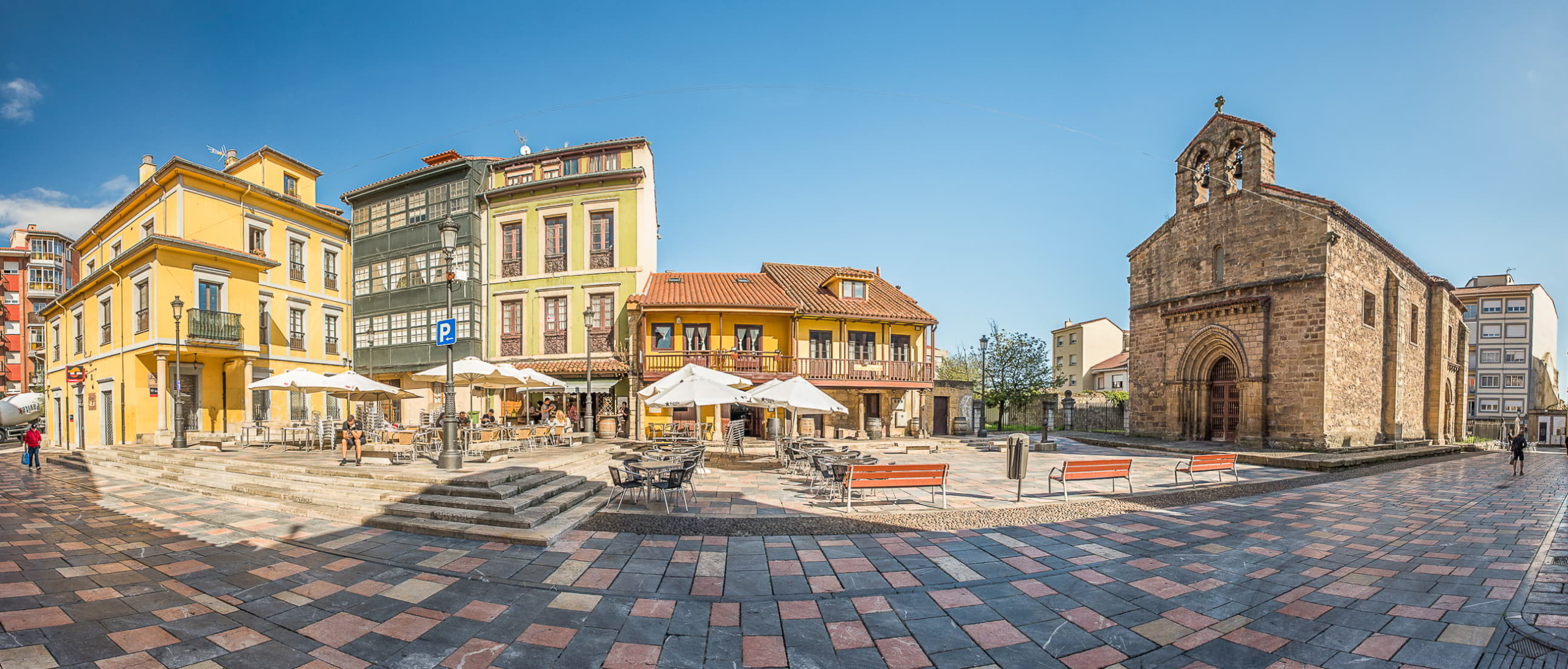
Avilés is a town (75,717 inhabitants) in Asturias, Spain.
Avilés is, along with Oviedo and Gijón, one of the main cities in the Principality of Asturias.
The town occupies the flattest land in the municipality, partially in a land that belonged to the sea, surrounded by small promontories, all of them having an altitude of less than 140 metres.
Situated in the Avilés estuary, in the Northern Central area of the Asturian coast, west of Peñas Cape, is its national seaport.
Avilés is mainly an industrial city. It is close to popular beaches like Salinas.
It also has important churches like St. Thomas of Canterbury.
Avilés has also cultural spaces such as the Palacio Valdés Theatre (Teatro Palacio Valdés) or the Oscar Niemeyer International Cultural Centre (in Spanish: Centro Cultural Internacional Oscar Niemeyer).
Sights include:
St. Thomas of Canterbury church (dating from the 13th century)
Church of Saint Nicholas of Bari (12th-13th century), in Romanesque style
Palacio de Valdecarzana, the sole example of civil medieval architecture in the town
Palacio de Llano Ponte (1700–1706)
Baroque Palacio de Camposagrado, fortified in its north façade against the English pirates
Capilla de los Alas, a 14th-century funerary monument in Romanesque-Gothic transition style
Old church of Sabugo (13th century)
Palacio de Balsera, in Modernist style
Palacio Valdés Theatre, in Neobaroque style
Museums and arts centres
Museum of Avilés Urban History
Black Pottery Museum
Alfercam Museum, where visitors can find a combination of world musical instruments and vintage cars.
Casa de Cultura, including the Bances Candamo public library, art gallery, reading and study areas.
CMAE – Centro municipal de arte y exposiciones – arts and exhibicion centre in El Arbolón area, not far from the town centre.

Oscar Niemeyer International Cultural Centre, designed by the Brazilian architect Oscar Niemeyer. It is a magnet for different personalities, including winners of the Prince of Asturias Awards, the Nobel Prize, musicians, actors, the United Nations, etc.
Sculptures
Throughout the town there are sculptures in various styles: the set of sculptures in El Muelle park, specially the Pedro Menendez sculpture and La foca (the Seal); the Ruta del acero (Steel Route) set of sculptures along the Avilés estuary; Avilés sculpture, and others such as Marta y María (Martha and Mary), El hombre que escucha la piedra (The Man who Listens to the Stone), El eslabón (The Link), Entre bambalines (Behind the Scenes).

