
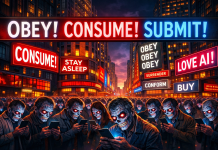
There are nights when literature ascends the mountaintop, communes with the muses, and returns bearing fire.
And then there are nights like June 6th 2026 in Chicago, US of A, when the Nebula Awards® unfurled their annual pageant of solemn absurdity, a glittering procession of “masterpieces” so radiant, so transcendent, so cosmically self‑satisfied that one could almost forget the whole enterprise is powered by caffeine, networking, and the collective delusion that speculative fiction is a meritocracy rather than a rotating carousel of fashionable darlings.
Take the Best Novel winner, The Buffalo Hunter Hunter, a title that sounds like a recursive fever dream or a graduate seminar in post‑post‑postmodern irony.
Stephen Graham Jones, a writer of undeniable talent, has apparently decided that the only thing more hunted than buffalo is the concept of subtlety.
The book is a triumph, we are told, though one suspects the real triumph is convincing two continents’ worth of publishers to print a title that reads like a glitch in the Matrix.
Then comes The River Has Roots, Amal El‑Mohtar’s novella, which sweeps in like a lyrical tornado determined to remind us that rivers, in fact, do have roots, and that metaphors can be weaponized with the precision of a drone strike.
It is beautiful, yes, but also the kind of beautiful that makes you feel vaguely guilty for not having a PhD in aquatic symbolism.
Thomas Ha’s Uncertain Sons wins Best Novelette, a victory that feels almost too on‑the‑nose.
Of course the Nebulas® would crown uncertainty itself.
Of course the winning story would be published in a venue named after itself.
It’s the ouroboros of literary prestige: the award devouring its own tail while nodding gravely about the importance of innovation.
Effie Seiberg’s short story, Laser Eyes Ain’t Everything, takes home its trophy with the swagger of a title that already knows it won.
It’s a reminder that in 2026, lasers are passé, eyes are optional, and irony is mandatory.
Meanwhile, the Andre Norton Award goes to Into the Wild Magic, a middle‑grade novel whose very existence proves that children’s literature is now officially more structurally coherent than most adult speculative fiction.
Michelle Knudsen delivers enchantment; the Nebulas® deliver applause; the rest of us deliver a sigh of relief that at least someone is writing for the future rather than the algorithm.
Game Writing? Ah yes, Clair Obscur: Expedition 33, a title that sounds like a perfume for time‑traveling aristocrats.
The developers at Sandfall Interactive have crafted something so atmospheric, so narratively ambitious, that one suspects the award committee simply gave up trying to understand it and handed over the trophy out of self‑preservation.
The Ray Bradbury Award goes to Murderbot: Season One, because of course it does.
Murderbot is the mascot of our age: anxious, overworked, emotionally exhausted, and just trying to get through the day without being rebooted. The Weitz brothers have adapted it into a show that is apparently so good it transcends the need for human protagonists.
Best Comic? Mary Shelley’s School for Monsters: The Killing Stone.
A title that suggests the author looked at the state of the world and thought, “You know what this needs? More monsters in school.”
Jessica Maison delivers, and the Nebulas® nod approvingly, as if Mary Shelley herself were somewhere in the ether muttering, “Finally, someone gets me.”
And then—history.
The inaugural NebulaAward® for Best Poem.
Jennifer Hudak’s The World To Come triumphs, proving once and for all that speculative poetry is no longer the quiet cousin at the family reunion but a fully armed participant in the literary arms race.
The world to come, indeed.
The honorary awards round out the ceremony with the gravitas of a pantheon roll call.
N. K. Jemisin ascends to Grand Master status, a coronation so overdue it feels like the universe correcting a clerical error.
David Langford receives the Solstice Award, presumably for being the only person alive who has read every fanzine ever published.
Gay Haldeman is honored for service, because someone has to keep the machinery of SFWA from collapsing into a singularity.
And the late Roger Zelazny receives the Infinity Award, which is fitting, since his influence has been infinite and his imitators innumerable.
In the end, the 2026 NebulaAwards® were exactly what they always are: a glittering, chaotic, self‑serious, occasionally brilliant carnival of ambition and acclaim.
A place where masterpieces are crowned, egos are inflated, and the speculative imagination is celebrated with the pomp of a royal coronation and the subtlety of a supernova.
And honestly? We wouldn’t have it any other way.
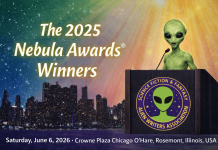
2025 Nebula Awards® Winners
Presented at the Crowne Plaza Chicago O’Hare, Rosemont, Illinois and online on Saturday, June 6, 2026.
Best Novel
Winner: The Buffalo Hunter Hunter, by Stephen Graham Jones (Saga; Titan UK)
Nominated works
When We Were Real, by Daryl Gregory (Saga)
Katabasis, by R.F. Kuang (Harper Voyager US; Harper Voyager UK)
Death of the Author, by Nnedi Okorafor (Morrow; Gollancz)
The Incandescent, by Emily Tesh (Tor; Orbit UK)
Sour Cherry, by Natalia Theodoridou (Tin House; Wildfire)
Wearing the Lion, by John Wiswell (DAW; Arcadia)
Best Novella
Winner: “The River Has Roots, by Amal El-Mohtar (Tordotcom; Arcadia)”
Nominated works
“Disgraced Return of the Kap’s Needle, by Renan Bernardo (Dark Matter INK)”
“The Death of Mountains, by Jordan Kurella (Lethe)”
“Automatic Noodle, by Annalee Newitz (Tordotcom)”
“But Not Too Bold, by Hache Pueyo (Tordotcom)”
““Descent”, by Wole Talabi (Clarkesworld 5/25)”
Best Novelette
Winner: ““Uncertain Sons”, by Thomas Ha (Uncertain Sons)”
Nominated works
““Our Echoes Drifting Through the Marsh”, by Marie Croke (Beneath Ceaseless Skies 1/9/25)”
““We Begin Where Infinity Ends”, by Somto Ihezue (Clarkesworld 2/25)”
“The Name Ziya, by Wen-Yi Lee (Tor)”
““Never Eaten Vegetables”, by H.H. Pak (Clarkesworld 1/25)”
““The Life and Times of Alavira the Great as Written by Titos Pavlou and Reviewed by Two Lifelong Friends”, by Eugenia Triantafyllou (Uncanny 3-4/25)”
Best Short Story
Winner: ““Laser Eyes Ain’t Everything”, by Effie Seiberg (Diabolical Plots 5/25)”
Nominated works
““Through the Machine”, by P.A. Cornell (Lightspeed 5/25)”
““Six People to Revise You”, by J.R. Dawson (Uncanny 1-2/25)”
““The Tawlish Island Songbook of the Dead”, by E.M. Linden (PodCastle 2/18/25)”
““In My Country”, by Thomas Ha (Clarkesworld 4/25)”
““Because I Held His Name Like a Key”, by Aimee Ogden (Strange Horizons 6/16/25)”
Ray Bradbury Nebula Award for Outstanding Dramatic Presentation
Winner: Murderbot: Season One, by Chris Weitz (Apple TV+)
Nominated works
Pluribus: Season One, by Vince Gilligan (Apple TV+)*
Sinners, by Ryan Coogler (Warner Bros Pictures)*
Severance: “Chikhai Bardo”, by Dan Erickson & Mark Friedman (Apple TV+)*
Superman, by James Gunn (Warner Bros Pictures)*
KPop Demon Hunters, by Danya Jimenez, Maggie Kang, & Hannah McMechan (Netflix)*
Andre Norton Nebula Award for Middle Grade and Young Adult Fiction
Winner: Into the Wild Magic, by Michelle Knudsen (Candlewick)
Nominated works
The Tower, by David Anaxagoras (Recorded Books)
Gemini Rising, by Jonathan Brazee (Semper Fi Press)
Wishing Well, Wishing Well, by Jubilee Cho (Atthis Arts)
Goblin Girl, by K.A. Mielke (self-published)
Sunrise on the Reaping, by Suzanne Collins (Scholastic)
Best Game Writing
Winner: Clair Obscur: Expedition 33, by Guillaume Broche, & Jennifer Svedberg-Yen (Kepler Interactive), Developer: Sandfall Interactive, Sandfall S.A.S.
Nominated works
Spire, Surge, and Sea, by Stewart C. Baker (Choice of Games)
Hollow Knight: Silksong, by Ari Gibson & William Pellen (Team Cherry)*
Dispatch, by Ashley Jeffalone, Suzee Matson, Chris Rebbert, Chad Rhiness, & Pierre Shorette (AdHoc Studios)
Hades II, by Greg Kasavin (Supergiant Games)
Blue Prince, by Tonda Ros (Raw Fury, Developer: Dogubomb)
Best Comic
Winner: Mary Shelley’s School for Monsters: The Killing Stone, by Jessica Maison (Wicked Tree)
Nominated works
Second Shift, by Kit Anderson (Avery Hill)
Carmilla Volume 3: The Eternal, by Amy Chu (Berger)
Helen of Wyndhorn, by Tom King (Dark Horse)
Fishflies, by Jeff Lemire (Image)
Strange Bedfellows, by Ariel Slamet Ries (HarperAlley)
The Flip Side, by Jason Walz (Rocky Pond)
The Stoneshore Register, by G. Willow Wilson (Berger)
Best Poem
Winner: “The World To Come”, by Jennifer Hudak (Strange Horizons 12/22/25)
Nominated works
“Though You Always Are”, by Linda D. Addison & Jamal Hodge (Everything Endless)
They Said Robots Are”, by Casey Aimer (Penumbric 6/25)
“The Mourning Robot”, by Angela Liu (Uncanny 9-10/25)
“To Be the Change”, by Nico Martinez Nocito (Strange Horizons 3/10/25)
“Care for Lightning”, by Mari Ness (Uncanny 1-2/25)
Video recording of the event is available here: https://www.youtube.com/watch?v=nmAxXj7-xxA
„The Nebula Awards have been described as one of “the most important of the American science fiction awards” and “the science-fiction and fantasy equivalent” of the Emmy Awards.
Along with the Hugo Award, the Nebula Award is also considered one of the premier awards in science fiction, with Laura Miller of Salon terming it “science fiction’s most prestigious award”, and Justine Larbalestier, in „The Battle of the Sexes in Science Fiction” (2002), referring to it and the Hugo Award as “the best known and most prestigious of the science fiction awards”.
Brian Aldiss, in his book „Trillion Year Spree: The History of Science Fiction”, claimed that the Nebula Award provided “more literary judgment” while the Hugo was a barometer of reader popularity, rather than artistic merit, though he did note that the winners of the two awards often overlapped.
David Langford and Peter Nicholls stated in „The Encyclopedia of Science Fiction” (2012) that the two awards were often given to the same works, and noted that some critics felt that the Nebula selection reflected “political as much as literary ability” as it did not seem to focus as much on literary talent over popularity as expected.
Several people within the publishing industry have said that winning or being nominated for a Nebula Award has effects on the author’s career and the sales of that work, publishers “pay careful attention” to who wins a Nebula Award. Literary agent Richard Curtis said in his 1996 „Mastering the Business of Writing” that having the term Nebula Award on the cover, even as a nominee, was a “powerful inducement” to science fiction fans to buy a novel, and Gahan Wilson, in „First World Fantasy Awards” (1977), claimed that noting that a book had won the Nebula Award on the cover “demonstrably” increased sales for that novel.”
DISCLAIMER
This text is a work of satire and fiction. It is a pamphlet, created solely for purposes of humor, commentary, artistic expression, and entertainment. Any resemblance to real persons, institutions, events, or situations is purely coincidental and not intended to represent, describe, or comment upon actual individuals or entities.
The content herein does not assert or imply any factual allegations, does not purport to describe real conduct, and does not aim to cause harm, prejudice, reputational damage, or moral injury to any person, institution, organization, or country. All characters, scenarios, and narrative elements are fictional constructs used in the context of legitimate creative expression.
This work is protected under the principles of freedom of expression, including satire and parody, as recognized by the European Convention on Human Rights, the Charter of Fundamental Rights of the European Union, and the First Amendment to the Constitution of the United States of America. It falls within the legally protected domain of opinion, commentary, and creative exaggeration.
No statements contained in this text should be interpreted as factual claims, legal assertions, or representations of real‑world events. The author expressly disclaims any intent to defame, mislead, or attribute actual actions or characteristics to any identifiable person or institution.
Any identification of this artistic endeavor through association with real events or persons is null and void, as the work does not refer to, depict, or imply any such connection. All interpretations suggesting otherwise are without merit, non‑binding, and legally irrelevant.
By reading this material, the reader acknowledges that it is a fictional, humorous, and satirical creation, and agrees that no legal, moral, or factual conclusions may be drawn from it.

