










Sci Phi Journal’s MARIANO MARTÍN RODRÍGUEZ & ÁDÁM GERENCSÉR: EUROPE’S DOUBLE‑ENGINE OF SPECULATIVE BRILLIANCE
There are magazines you read, and then there are magazines that grab you by the collar, drag you across continents, and drop you into the heart of an intellectual storm.
Sci Phi Journal is the latter.
It doesn’t whisper ideas—it detonates them.
It doesn’t politely invite you to think—it dares you to keep up.
And the story of how it became this kind of publication is almost as wild as the fiction it publishes.
It began far from Europe, under the blazing Australian sun.
Back in October 2014, Jason Rennie and Ben Zwycky launched a bold experiment: a literary space where science fiction and speculative philosophy could collide at full speed.
For five years, they steered the ship, with Ray Blank briefly taking the helm afterward.
We owe them gratitude—real gratitude—for planting the seed.
Without that Australian spark, none of what followed would exist.
But then came the European era.
And everything changed.
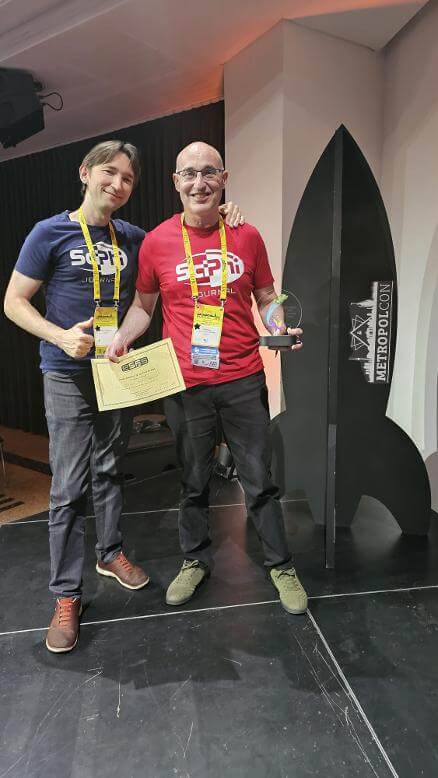
When Spaniard Mariano Martín Rodríguez (right) and Hungarian Ádám Gerencsér (left) took over in January 2019, the journal didn’t just continue—it transformed. Their photo was taken by Sara Avram.
What had been a promising concept became a cultural force.
Seven years later, their European chapter has outgrown the original Australian phase in scope, ambition, and sheer intellectual voltage.
Under their leadership, Sci Phi Journal became a place where ideas breathe fire.
The editors don’t simply curate stories; they orchestrate collisions between anthropology, theology, hard SF, alternative history, and speculative metaphysics.
They champion fiction that thinks—fiction that interrogates reality, pokes at the boundaries of knowledge, and refuses to settle for the ordinary.
Reading Sci Phi Journal feels like stepping into a secret society of thinkers who use imagination as a weapon.
The prose is sharp, the concepts are daring, and the editorial vision is unmistakably European: cosmopolitan, erudite, and gloriously uncompromising.
Mariano Martín Rodríguez and Ádám Gerencsér have turned the magazine into a beacon for writers who crave depth and readers who crave meaning.
They’ve built a home for short fiction that punches above its weight, essays that challenge your assumptions, and that wonderfully strange hybrid known as “fictional non-fiction,” which treats invented worlds with academic seriousness and mischievous delight.
And the world has noticed.
Awards, exhibitions, recognition across the continent—Sci Phi Journal has become a cultural landmark, a place where speculative literature proves its intellectual muscle.
But here’s the real reason you should read it:
Because Sci Phi Journal is alive.
It vibrates with curiosity.
It hums with philosophical tension.
It invites you into a conversation that spans galaxies and centuries, yet feels urgent and personal.
It’s the kind of publication that makes you sit up straighter, think harder, and see the world differently.
If you want fiction that entertains, you have options.
If you want fiction that awakens you, you read Sci Phi Journal.
And once you start, you won’t stop.
Enter the electric mindscape.
Join the readers who crave ideas with teeth.
Sci Phi Journal is waiting for you!
Sci Phi Journal stands today as one of the most intellectually vibrant and artistically daring literary venues in the European cultural sphere, a publication whose very existence seems to affirm that speculative fiction can be a crucible for serious thought.
At its helm are since January 2019, two editors whose erudition and breadth of vision have become inseparable from the magazine’s identity: the Spaniard Mariano Martín Rodríguez and the Hungarian Ádám Gerencsér.
Their partnership has shaped the journal into a meeting place for rigorous philosophical inquiry and imaginative storytelling, a space where ideas are treated with the same reverence as narrative craft.
Under their guidance, Sci Phi Journal has evolved into a rare kind of publication—one that refuses to dilute intellectual ambition for the sake of accessibility, yet remains welcoming to readers who crave fiction that challenges, provokes, and expands the mind.
Mariano Martín Rodríguez and Ádám Gerencsér bring to the editorial table a distinctly European sensibility: cosmopolitan, historically aware, and unafraid of complexity.
Their editorial choices reveal a deep familiarity with the traditions of speculative thought, from classical philosophy to modern anthropology, from theological speculation to the hard sciences.
This erudition does not weigh down the journal; instead, it elevates it, giving each issue a sense of coherence and purpose that is increasingly rare in contemporary literary culture.
The magazine’s focus on concept-driven fiction—stories that revolve around ideas rather than mere plot mechanics—reflects the editors’ conviction that science fiction and fantasy are not escapist genres but intellectual laboratories.
In their hands, Sci Phi Journal becomes a place where alternative histories illuminate present dilemmas, where solarpunk aesthetics gesture toward ethical futures, where hard SF grapples with the limits of human knowledge, and where theological fantasy reopens ancient questions with modern urgency.
Even its hybrid “fictional non-fiction” pieces, a hallmark of the publication, demonstrate a playful yet disciplined approach to speculative world-building, treating invented realities with the seriousness of academic inquiry.
Mariano Martín Rodríguez and Ádám Gerencsér have also cultivated a community of writers—emerging and established—who share their appetite for depth.
The journal’s open submissions policy is not merely a procedural detail; it is an invitation to participate in a tradition of intellectual storytelling that values clarity of thought as much as literary elegance.
Their editorial stewardship encourages experimentation, rewards originality, and consistently upholds a standard of excellence that has earned Sci Phi Journal recognition across the European SFF landscape, including major awards and cultural exhibitions.
What makes their leadership remarkable is not only the quality of the work they publish, but the cultural project they embody.
Sci Phi Journal, under their direction, is more than a magazine: it is atribute to the idea that speculative fiction can be a serious art form, one capable of engaging with philosophy, history, ethics, and the human condition without sacrificing imagination.
It is a European project in the truest sense—rooted in intellectual tradition, open to global perspectives, and animated by a belief in literature’s power to illuminate the unknown.
In an era dominated by rapid consumption and superficial narratives, Mariano Martín Rodríguez and Ádám Gerencsér have carved out a sanctuary for thoughtful readers and ambitious writers.
Their editorial excellence ensures that Sci Phi Journal remains not only relevant, but indispensable: a beacon for those who believe that the future of literature lies in the fertile intersection of wonder and wisdom.
Sci Phi Journal is a cosy waystation for travellers who, through no fault of their own, find themselves at the cosmic intersection between speculative philosophy, cultural anthropology and hard SF.
The most recent incarnation of Sci Phi Journal , as our gathering place is known for short, was launched in Australia back in 2014 by Jason Rennie, of erstwhile Sci Phi Show podcasting fame (or infamy), and helmed by Ray Blank through the stormy year of 2017.
It spent 2018 in hibernation and was re-launched as a European project in 2019 under co-editors Mariano Martín Rodríguez and Ádám Gerencsér.
Based in Brussels, Belgium, Sci Phi Journal was kindly honoured by a number of international nominations over its run thus far, including Hugo, Locus and Utopia, and the European Science Fiction Society (ESFS) voted to bestow on it the 2022 European SF Award for Best Magazine.
As its primary mission, Sci Phi Journal wishes to provide a platform for idea-driven fiction, as opposed to the ‘character-driven’ mode that has come to predominate speculative fiction.
The co-editors are hoping that, in the fullness of time, Sci Phi Journal may also act as a catalyst for discussion among mind-mates scattered around the globe, united in our attraction towards the philosophical edge of the SF spectrum.
And yes—every issue of Sci Phi Journal is freely downloadable as a PDF.
The Sci Phi Journal‘s 2026/2 Summer Issue is already up for grabs, ready for you to print, annotate, devour on your tablet, or read under a tree somewhere while the universe unfolds in your hands. The latest edition waits with open arms—always free, always accessible, always brimming with mind‑sparking ideas.

