






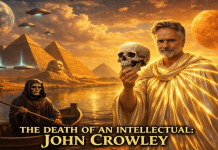
JOHN CROWLEY: December 1, 1942 – August 8, 2026 RIP!
John Crowley is gone, and with him vanishes one of the last great American minds who dared to treat science fiction not as a playground of gadgets, but as a cathedral of ideas.
His death on August 8, 2026, closes a long, intricate, stubbornly luminous career—one that refused to bow to the literary establishment even as it quietly outclassed it.
He moved through the world like a scholar who had misplaced his monastery and decided, with a shrug and a smile, to build one out of stories instead.
John Crowley was never seduced by the chrome-plated futurism that lured so many writers of his generation.
What drew him to SF was something older, stranger, more ceremonial: the possibility that the world could be re-enchanted through narrative.
He understood instinctively that the genre’s true power lay not in predicting tomorrow’s machines but in resurrecting yesterday’s metaphysics.
In “The Deep”, he took a flat discworld balanced on a cosmic pillar and turned it into a meditation on authority, memory, and the terrible pleasure of gods who toy with mortals.
In “Engine Summer”, he transformed a dying pastoral America into a crystalline loop of remembrance, a story that knows it is a story replaying itself forever.
“For the Story is all,” the text insists, and Crowley spent his life proving it.
He was an intellectual of the old breed—erudite without pomposity, curious without limit, capable of reading Renaissance hermeticism in the morning and writing about genetically engineered lion-humans in the afternoon.
His correspondence with Harold Bloom was not a publicity stunt but a genuine meeting of minds.
Harold Bloom recognized in John Crowley what academia rarely does: a novelist who treated myth, memory, and metaphysical architecture with the seriousness of a medieval theologian and the playfulness of a trickster god.
That recognition carried John Crowley to Yale University, where he taught utopian fiction and creative writing, slipping SF into the bloodstream of students who had never imagined the genre could be a vehicle for intellectual grandeur.
John Crowley taught at Yale University between the years 1993 and 2018, as Senior Lecturer in English, where he focused primarily on teaching creative writing and fiction.
John Crowley’s fiction was never content to sit quietly on the shelf labeled “fantasy” or “science fiction.”
“Little, Big”—his great, mournful, baroque masterpiece—was a requiem for America disguised as a fairy tale.
Edgewood, the quincunx-shaped house at its center, is “bigger inside than out,” a line that could serve as the motto for John Crowley’s entire oeuvre.
His books expand as you read them, revealing chambers you didn’t know were there, corridors that lead not forward but inward.
He wrote as if the world itself were a palimpsest of forgotten architectures, and he alone could still see the original blueprint.
What kept him tethered to SF, even as he wandered through historical fiction, Renaissance magic, and mythic Americana, was the genre’s willingness to let him build universes where metaphysics mattered.
He was never interested in the literal machinery of time travel or the physics of alternate worlds; he cared about the moral and symbolic consequences of those inventions.
In “Great Work of Time”, he turned temporal manipulation into a tragedy of hubris.
In the “Ægypt” cycle, he treated Renaissance neoplatonism as if it were a parallel cosmos shimmering just behind the visible one.
He wrote SF the way a Renaissance alchemist might have written it—half scholarship, half spell.
John Crowley maintained his status as a public intellectual precisely because he refused to apologize for writing SF.
He treated genre as a legitimate philosophical instrument, and in doing so, he forced readers to confront the possibility that the boundaries between “literary” and “speculative” were nothing more than polite illusions.
He taught at Yale not as a genre ambassador but as a novelist whose work demanded serious attention.
His lectures on utopian fiction were not about escapism; they were about the architecture of hope.
His screenwriting and documentary work were extensions of the same impulse: to understand how stories shape the world, and how the world, in turn, shapes the stories we tell.
He never enjoyed massive commercial success, but he built something rarer: a career of permanent significance.
Critics championed him; Harold Bloom adored him; readers who found him tended to keep him close, like a secret talisman.
And yet the literary establishment mostly ignored him, a neglect so absurd it feels like a cosmic joke.
John Crowley spent his life writing about worlds governed by mysterious authorities, and in the end, the real-world authorities of literature proved just as blind and arbitrary as the gods in “The Deep”.
John Crowley leaves behind a body of work that feels less like a bibliography and more like a constellation—stories connected by invisible lines, glowing with the melancholy of lost worlds and the stubborn hope that meaning can still be found if one walks far enough into the forest.
His death is not merely the passing of a writer; it is the dimming of a particular kind of American intellect, one that believed stories could still remake reality.
He understood that the further in you go, the bigger it gets.
And now he has gone further in than any of us can follow.
RIP!

