








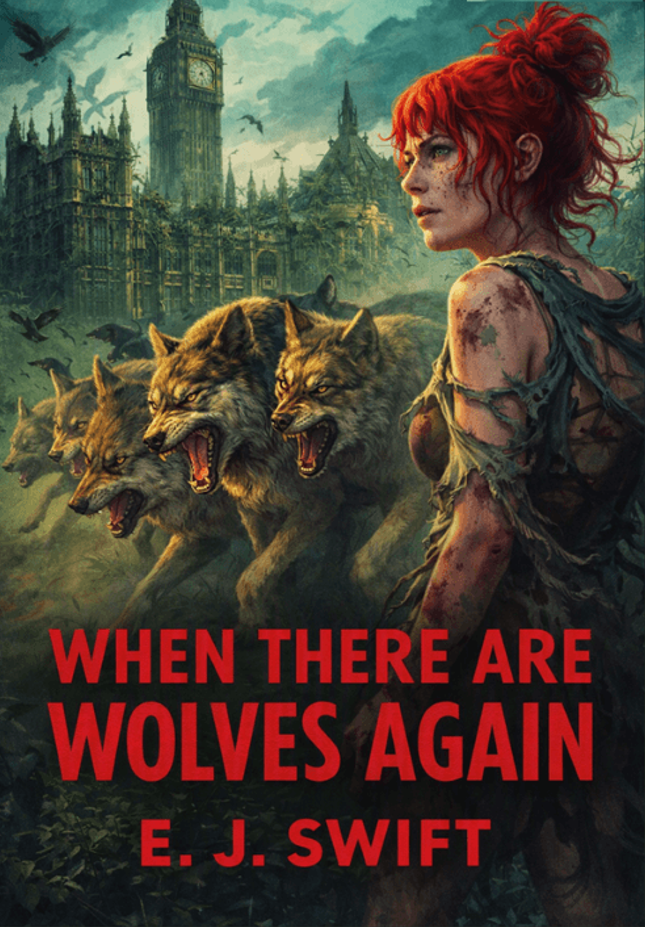
“WHEN THERE ARE WOLVES AGAIN” BY E.J. SWIFT, HAS WON THE 2026 ANNUAL ARTHUR C. CLARKE AWARD
The night they announced the Clarke Award felt like one of those evenings when the air itself is holding its breath.
London—still pretending it’s a city rather than a long, slow collapse in architectural form—buzzed with the usual cocktail of self‑importance and dread.
And then the news detonated: “When There Are Wolves Again” had taken the prize.
E.J. Swift, Emma J. Swift in the daylight world, walked away with the engraved bookend and the money, but what she really claimed was something stranger, heavier, more radioactive.
She claimed the future.
Because this book isn’t just a novel.
It’s a warning flare fired from the last habitable ridge of a country that has forgotten what it means to be alive.
E.J. Swift’s Britain is a place where the polite fictions have finally rotted through.
The hedgerows are skeletal, the rivers are sullen, and the cities—those once‑proud engines of empire—have become mausoleums for a species that mistook convenience for destiny.
And then, out of the fog and the ruins, the wolves return.
Not metaphorically. Not symbolically.
Actual wolves, padding through the undergrowth of a nation that once exterminated them with bureaucratic enthusiasm.
The book asks the question everyone is too afraid to voice: is this good?
Is the rewilding of Britain a kind of ecological redemption, a long‑overdue apology to the planet?
Or is it simply the final stage of collapse, the moment when the animals reclaim the land because the humans have forfeited their right to it?
E.J. Swift doesn’t answer.
She prowls around the question, teeth bared, letting the reader feel the hot breath of possibility on their neck.
The wolves are salvation. The wolves are doom. The wolves are neither. The wolves are both.
They are the mirror held up to a civilization that has spent centuries insisting it was the apex predator, only to discover it was just another animal with delusions of grandeur.
Her characters—Lucy, shaped by lockdowns and activism, and Hester, carrying the radioactive ghosts of Chornobyl—move through this half‑century like two fault lines waiting to intersect.
Their lives are not heroic; they are stubborn. They cling to hope the way a drowning person clings to driftwood.
And in E.J. Swift’s world, hope is not a virtue. It is a weapon.
It is the last tool left when the infrastructure has failed, the governments have faltered, and the climate has stopped pretending it can be negotiated with.
What makes the novel so devastating is its refusal to flatter the reader.
There is no triumphant human resurgence, no clever technological fix, no last‑minute reprieve.
The wolves don’t arrive as symbols of harmony.
They arrive because the land has finally shrugged off enough human interference to allow them back.
They arrive because the world is healing in ways that do not require us.
And yet—E.J. Swift threads a thin, trembling line of optimism through the wreckage.
Not the saccharine optimism of policy papers or TED talks, but the feral, bone‑deep kind that comes from accepting that survival is not guaranteed and acting anyway.
Her Britain is not saved, but it is no longer dying quietly.
It is fighting, clawing, regrowing, remembering.
The Clarke Award’s judges called it a story of “environmental change and possible recovery.”
That phrase is doing a lot of heavy lifting.
Recovery, in E.J. Swift’s vision, is not a return to what was.
It is a transformation into something unrecognizable, something wilder, something that may not have room for us in the ways we expect.
So yes, the wolves are a metaphor. And no, they are not only a metaphor.
They are the future stalking toward us on silent feet, indifferent to our nostalgia, unimpressed by our achievements, ready to inherit whatever remains.
E.J. Swift didn’t just win the Clarke Award.
She cracked open the skull of British speculative fiction and poured in a vision of the next fifty years that is as intoxicating as it is terrifying.
If this is the literature of the climate era, then the genre has finally stopped whispering warnings and started howling.
And the howl, disturbingly, sounds like home.
The winner was announced at an award ceremony in London on August 12, 2026.
The 2026 judges were Eliza Filimon for the British Science Fiction Association, Tiffani Angus and John Coxon for the Science Fiction Foundation, and Esther Stewart for the SCI-FI-LONDON film festival. Andrew M. Butler represented the Clarke Award directors as non-voting Chair of the Judges.
E.J. Swift received £2,025 (€2,369.25) and an engraved bookend.

