







GIAN PAOLO COSSATO & GIANLUIGI MISSIAJA
The first Eurocon was held in Trieste, Italy, 12-16 July 1972. There were three guests of honor, John Brunner for the United Kingdom, Kurt Steiner (André Ruellan) for France and Roberto Vacca for Italy.
Forrest Ackerman, Brian Aldiss, Peter Nicholls, Pierre Barbet, Daniel Drode, Peter Kuczka, Ion Hobana, were in attendance as well Gustavo Gasparini who was also toastmaster, and others.
The European Science Fiction Society (ESFS) is an international organisation of professionals and fans who are committed to promoting science fiction in Europe and European science fiction worldwide.
The organisation was founded at the first Eurocon (European Science Fiction Convention), which was held in July 1972 in Trieste, Italy.
Since that time, the organisation has organized Eurocons at least every two years. The organisation also administrates the European SF Awards.
The story begins in the narrow calli of Venice, where the lagoon smells of salt and old stone, and where the future seems an improbable guest.
It was the early 1960s, in the labyrinthine alleys of Venice, where the scent of saltwater mingled with the weight of ancient stone, and the future didn’t wait to be welcomed — it imposed itself.
Yet, it was there that two young Venetians—Gian Paolo (Giampaolo) Cossato and Gianluigi Missiaja—dared to imagine science fiction not as a niche hobby, but as a cultural revolution.
They were barely out of their teens, but their vision was anything but juvenile.
They were not merely fans.
They were not collectors of paperbacks or weekend dreamers drifting through the neon haze of pulp covers.
Gian Paolo (Giampaolo) Cossato and Gianluigi Missiaja (1943-2023) were something far rarer: two young Venetians who believed, with the stubborn fire of true believers, that science fiction could be a cultural force — an European force — long before anyone else dared to imagine it.
Yet it was precisely there, in 1962, that these two teenagers — one still in middle school, the other barely out of it — founded the Centro Cultori Science Fiction (Center for Science Fiction Enthusiasts), a name chosen deliberately to escape the ghetto of “fan clubs.”
Centro Cultori Science Fiction, a name chosen to escape the confines of fan clubs and instead place science fiction on the same shelf as literature, philosophy, and cinema.
And so, the seeds of something extraordinary were planted.
They wanted science fiction to stand shoulder to shoulder with literature, philosophy, cinema, and the restless intellectual life of Italy. And they made it happen.
The SF club played a pioneering role in spreading science fiction in Italy, treating it not just as entertainment but as a medium for critical and social reflection.
The main achievements of the Center and its founders include: In 1964, the historic magazine Urania published two announcements from the CCSF.
This triggered the opening of club branches all over Italy and later led to the creation of the SF Premio Italia.
The Newsletter: Starting in 1965, the Center published its own newsletter featuring articles and reviews, helping introduce the SF genre across different media.
Gian Paolo Cossato, the polyglot wanderer, built an international network with nothing but a typewriter and an almost reckless determination.
He wrote letters across continents, stitching together fans from London, Heidelberg, Budapest, Trieste, and beyond.
He smuggled banned SF magazines into Australia, carried manuscripts across borders, and treated fandom not as a hobby but as a diplomatic mission.
He was the bridge — the one who connected Europe’s fragmented SF tribes to the Anglo‑American giants.
Cossato, the restless polyglot, became the architect of connections.
Armed with nothing but a typewriter and an unshakable belief, he wove a web of correspondence that stretched from London to Budapest, from Trieste to Heidelberg.
He smuggled banned SF magazines, carried manuscripts across borders, and treated fandom like a diplomatic mission.
Meanwhile, Missiaja, the anchor, remained in Venice, turning ideas into reality—organizing, printing, stapling, and mailing the physical heartbeat of a movement that was outgrowing its own skin.
Together, they built a bridge between Europe’s fragmented science fiction tribes and the Anglo-American giants, proving that passion could outpace institutions.
Then came the moment that changed everything: Heicon ’70, the 28th World Science Fiction Convention, held in Heidelberg, West Germany, in August 1970.
For the first time, Worldcon crossed the Atlantic, breaking the North American monopoly.
Cossato had spent years aligning European fandom with British and German allies, rallying support through articles, petitions, and sheer persistence. The bid was unanimous, the victory historic. Heidelberg became the stage where Europe proved it could host the world.
But the real magic happened two years later, in July 1972, in Trieste—a city perched on the edge of the Cold War, where the Iron Curtain felt tantalizingly thin.
Eurocon I was born, the first European Science Fiction Convention, and it was nothing short of a miracle.
Missiaja, as president, orchestrated the logistics with the precision of a maestro, while Cossato, the international coordinator, pierced political boundaries to invite writers, critics, and dreamers from both sides of the divide.
Trieste became a meeting point for East and West, a place where science fiction transcended ideology.
Heicon ’70 (Heidelberg): The 28th World Science Fiction Convention, known as Heicon ’70, took place from August 20–24, 1970, at the Stadthalle in Heidelberg, West Germany.
The Historical Shift: Before 1970, Worldcon had almost exclusively been a North American event.
Breaking this monopoly required an incredible international effort.
Cossato’s Global Networking: Giampaolo Cossato was a key driver of this milestone. Using his boundless passion and his typewriter, he built a dense, complex web of connections with prominent European and British science fiction fans and authors.
The Unified Bid: Cossato, collaborating with German fandom figureheads like Hans-Werner Heinrichs and backed by UK fans (who supplied a petition with over 150 signatures), created a highly organized unified front.
The Pitch and Victory: At the St. Louiscon business session in August 1969, the Heidelberg team pitched the central European location as highly accessible.
They promised a truly international, bilingual program featuring simultaneous translations and massive cultural experiences (like banquets inside Heidelberg Castle). Following the withdrawal of rival locations, Heicon ’70 won a unanimous vote.
This marked the first Worldcon in continental Europe, changing global fandom forever.
Gianluigi Missiaja, the anchor, remained in Venice.
He organized, catalogued, printed, stapled, mailed, and managed the physical reality of a movement that was beginning to outgrow its own skin.
He was the logistical soul of CCSF, the man who turned ideas into events, newsletters, fanzines, and eventually into a cultural institution: Libreria Solaris (Bookshop), the first Italian bookshop dedicated entirely to science fiction. For decades, Solaris was a lighthouse for generations of Italian fans — a place where the future was sold across the counter, wrapped in paper and imagination.
Together, they achieved the impossible.
They contributed to bring Worldcon to continental Europe in 1970.
The true origin of the Eurocon concept lies within West German science‑fiction fandom of the 1950s.
The history of the German SF movement, especially the activity of the Science Fiction Club Deutschland (SFCD), shows clearly that the idea of a European science‑fiction structure was formulated there long before any Eastern European states became involved.
In 1958, Walter Ernsting — known under the pseudonym Clark Darlton — renamed SFCD as the Science Fiction Club Europe (SFCE), marking the first official use of the notion of “Science Fiction Europe” and expressing an explicit intention to build a pan‑European SF community.
One year later, in 1959, Ernsting founded the Science Fiction Union Europa (SFUE), the first organized project that pursued precisely what ESFS would become a decade later: a European network of authors, editors, and fans from multiple countries.
During the same period, the German‑speaking fandom hosted SF conventions with international ambitions, such as Wetzcon 1956, organized by SFCD and attended by participants from the United Kingdom, Belgium, and the United States.
Historians regard these gatherings as proto‑Eurocons because they were held under the umbrella of SFCD, SFCE, or SFUE and promoted the idea of a united European SF community with free circulation of ideas and creators.
Taken together, the concept of Eurocon is entirely Western, Germanophone, and already well‑defined in the 1950s, long before Trieste 1972 institutionalized what West German fandom had been building in practice.
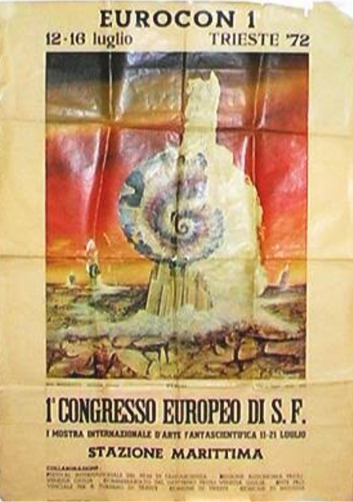
Organizing the First European Science Fiction Convention: Eurocon I (Trieste, 1972)
Following the momentum of Heicon ’70, Giampaolo Cossato and Gianluigi Missiaja—leveraging their Venetian club, the Centro Cultori Science Fiction (CCSF)—wanted a dedicated event to unite the fragmented science fiction communities of Europe.
Breaking the Iron Curtain: The most significant hurdle of the era was the Cold War.
Geopolitically, Italy sat right at the edge of the Western bloc.
Cossato used his extensive international letter-writing network to pierce through political boundaries.
He successfully invited, coordinated, and brought over authors, critics, and journalists from Eastern Bloc countries.
Giampaolo Cossato and Gianluigi Missiaja invited writers from both sides of the Iron Curtain, convinced cultural institutions to support them, and forged an international committee representing nineteen countries. This turned Eurocon into a historic bridge between East and West.
And then, in July 1972, they created Eurocon I, the first European science fiction convention – Eurocon I, held from July 12–16, 1972, in Trieste, Italy….Trieste — a city perched on the edge of the Cold War.
Gianluigi Missiaja was the chairman of the first Eurocon, held in Trieste.
High-Profile Patronage: Missiaja and Cossato elevated the event beyond standard “geek fandom” by integrating it with high culture.
They secured the support and patronage of key cultural figures, notably Flavia Paulon (a major organizational mind behind the Venice Film Festival).
Gianluigi Missiaja took on the massive logistical pressure, serving as the President of this inaugural Eurocon.
Lasting Cultural Footprints
The event was a massive success, marked by the founding of ESFS at the First Eurocon (Trieste, 12–14 July 1972)
The European Science Fiction Society (ESFS) was formally founded during the first Eurocon, held in Trieste, Italy, in July 1972, as a pan‑European initiative to connect science‑fiction professionals and fans across both Western and Eastern Europe.
The idea of establishing a continent‑wide organisation emerged from meetings among Western European fandom at Heicon 1970, which inspired the creation of a permanent structure for cooperation.
At Trieste, the founding group included writers, editors, and fans from multiple countries on both sides of the Iron Curtain.
Among the documented co‑founders was the French writer Pierre Barbet, explicitly listed as a founding member.
The convention itself gathered participants from Western nations such as Italy, France, the United Kingdom, Belgium, the Netherlands, Spain, and Sweden, as well as from Communist countries including Hungary, Romania, and Yugoslavia, whose delegates and writers were present and active in the event’s organisation and discussions.
The successful collaboration across political blocs — made possible by the détente climate of the early 1970s — allowed ESFS to be established as a truly pan‑European body, committed to promoting European science fiction and administering the European SF Awards.
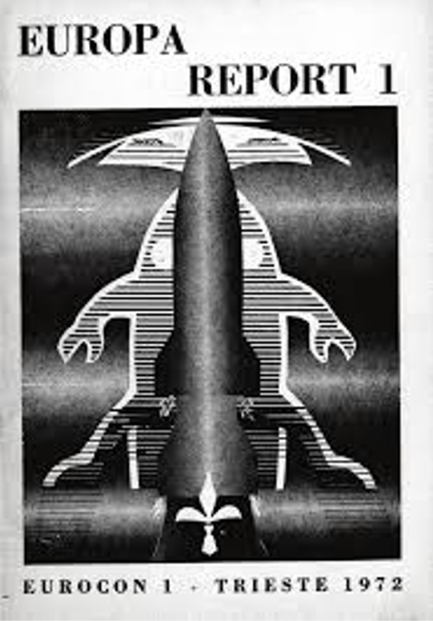
This is confirmed by the release of the landmark Europa Report 1 fanzine published by the Centro Cultori Science Fiction.
They did all this without funding, without internet, without institutional backing — only with conviction, letters, and the audacity of youth.
Cossato and Missiaja were not just founders.
They were Europeanists in the deepest sense: believers in a continental imagination, in a shared future, in the idea that science fiction could unite cultures divided by language, politics, and history.
They were dreamers who refused to dream alone.
Today, as Eurocon continues its wandering pilgrimage across Europe, their legacy remains woven into every badge, every panel, every gathering of fans who still believe that the future is a story worth telling.
Giampaolo Cossato and Gianluigi Missiaja were the Italian founding fathers of Eurocon — two men who looked at the venetian lagoon, saw the stars reflected in the water, and decided that Europe deserved its own place among them.
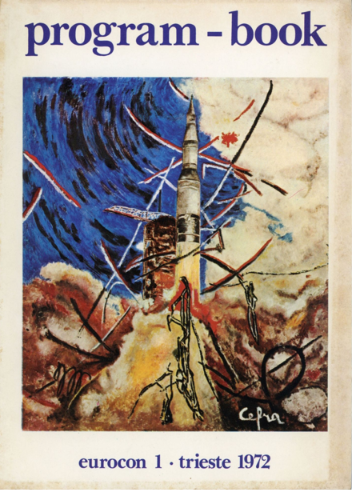
EUROCON 1, TRIESTE, ITALY
ESFS AWARDS
- Artist: Karel Thole (Italia)
- Specialized Professional Magazine: Nueva Dimensión (New Dimension, Spain)
- Non-Specialized Professional Magazine: Viata Romaneasca (Romanian Life, Romania)
- Fanzine: Speculations (United Kingdom)
- Comics: Lone Sloane, by Philippe Druillet (France)
- Novel:
- Belgium – Sam, Paul Van Herck;
- France – Ortog et les tenebres (Ortog and the Darkness), Kurt Steiner;
- Hungary – A Feladat (The Task), Peter Zsoldos;
- Italy – Autocrisi (Autocrisis), Pierfrancesco Prosperi;
- Olanda – De naakten en de speyers (The Naked and the Trackers), Jacob Carossa;
- România – Vă caută un taur (A Bull is Looking For You), Sergiu Fărcășan;
- Spain – Amor en una Isla Verde (Love on a Green Island), Gabriel Bermudez;
- Sweden – Deta ar Verkligheten (This Is Reality), Bertil Matensson;
- United Kingdom – All Judgement Fled, James White;
- Short Story:
- Belgium – De 8 jaarlijkse God (The Eight‑Year God), Eddy C. Bertin;
- France – L’Assassinat de l’Oiseau Bleu (The Assassination of the Blue Bird), Daniel Walther;
- Hungary – Sempiternin, Lajos Mesterhazi;
- Italy – Dove Muore l’Astragalo (Where the Astragalus Dies), Livio Horrakh;
- Netherlands – Egeïsche Zee (Aegean Sea), Carl Lans;
- Romania – Altarul Zeilor Stohastici (The Altar of the Stochastic Gods), Adrian Rogoz;
- Sweden – Spranget (The Leap), Carl Johan Holzhausen;
- United Kingdom – Lucifer, Edwin C. Tubb;
- Dramatic production:
- Denmark – Man Den, Der Tankte Ting / The Man Who Thought Things (Film);
- Italy – La Ragazza di Latta / The Tin Girl (Film);
- Netherlands – De Kleine Mannetjes van Mars / The Little Men from Mars (Radiophonic play for children);
- Sweden – Deadline (Film);
- United Kingdom – UFO (TV Serial);
- Artists:
- France – Jean-François Jamoul;
- Hungary – Andras Miklos Saros;
- Netherlands – N. van Welzenes;
- România – Nicolae Săftoiu;
- Spania – Enrique Torres (Enric);
- Sweden – Sven O. Gripsborn;
- United Kingdom – Arthur Thompson (Atom);
- Best Specialized Professional Magazine: Galassia (Spain)
- Best Non‑Specialized Professional Magazine:
- Belgium – Ciso – SF & Comics;
- France – Le Magazine Litteraire: La Science-Fiction (The Literary Magazine: Science Fiction;
- Italy – Fena rete: Fantascienza & Futuribile (Fena Network: Science Fiction & Futurible);
- Netherlands – Stripschrift: SF & Comics;
- Spania – Yorick: Teatro y Ciencia-Ficcion; (Yorick: Theatre and Science Fiction)
- Fanzines:
- Austria – Quarber Merkur;
- Belgium – Kosmos;
- France – Nyarlathotep;
- Hungary – SF Tajekoztato;
- Italy – Notiziario CCSF;
- Netherlands – Holland-SF;
- România – Solaris;
- Spania – Fundacion;
- Sweden – SF Forum;
- Turkey – Antares;
- Comics:
- Belgium – Yoko Tsuno, R. Leloup;
- Netherlands – Arman en Ilva, The Tjong King;
- Spania – Haxtur, Victor de la Fuente;
- Sweden – Blixt Gordon, Lars Olsson;
- Essays, biographies, and bibliographies:
- Hungary – A Fantazia Irodalma (The Literature of Fantasy), Laszlo Urban;
- Netherlands – 100 jaar SF in Nederland (100 Years of SF in the Netherlands), Dick Scheepstra;
- Romania – Vârsta de Aur a Anticipației Românești (The Golden Age of Romanian Science Fiction), Ion Hobana;
- Spania – La SF: Contramitologia del Siglo XX (Science Fiction: The Counter‑Mythology of the 20th Century), Carlo Frabetti (Essay);
- Ray Bradbury – Humanista del Futuro (Ray Bradbury – Humanist of the Future), Jose Luis Garci (Book);
- Sweden – SF Articles in ‘Sydsvenska Dagbladet’ (South Swedish Daily), Sven Christer Swahn;

