








Broligarchy: The age of monomaniac messianic billionaires and techno-fascist sociopaths who believe that a hoodie is a political philosophy.
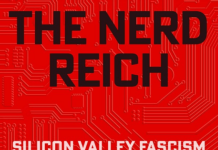
“Silicon Valley has gone fascist because they have adopted an extreme ideology of tech supremacy. While Maga promises a return to a mythical glorious past, the “technofascists” are promising a mythical glorious future: We’re going to be in the stars. We’re going to be in space. And all we need is to get rid of anybody who stands in our way as we seek to accelerate technology toward this speedy, violent, God-like transcendence that we will achieve if we can only burn enough energy and enough compute to bring our boom loop into existence. It’s the idea that what matters more is the billions or trillions of people yet unborn in the future. And the only way they’re going to get to be born is if this elite group of white tech figures and gazillionaires makes the right decisions to make the human race transhuman and multiplanetary through AI and technology.” – Gil Durán, “The Nerd Reich: Silicon Valley Fascism and the War on Democracy”
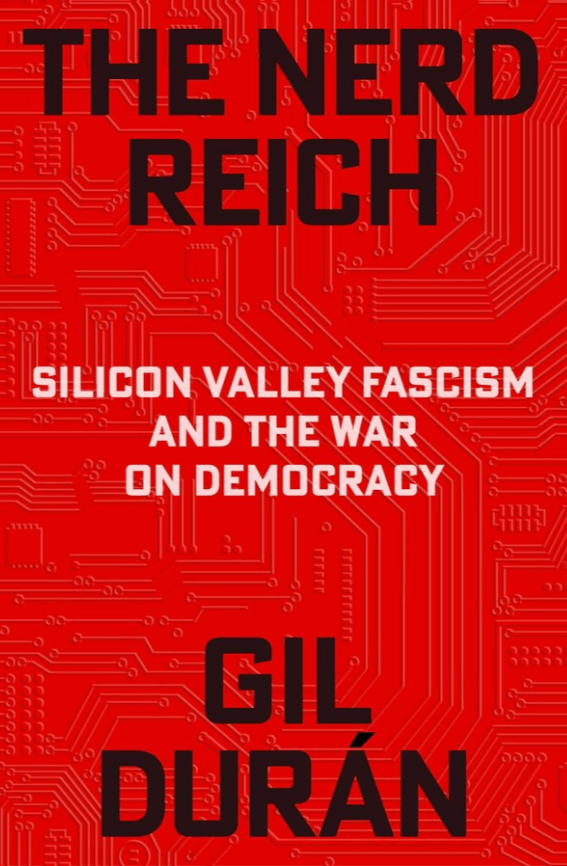
“Picture this: A loosely organized cabal of obscenely wealthy tech moguls aim to overthrow democracy and replace it with a corporatist dictatorship. It would make for a good political SF thriller. It’s a far grimmer read in nonfiction. This is a story about the toxic effects of too much money in the hands of small-minded men who have way too much power in society because of it. Instead of promising a return to a mythical past, the tech fascists promise a mythical future: superabundance, interplanetary travel, eternal life, total efficiency!“
They emerge from their glass pyramids in Palo Alto like malfunctioning demigods, clutching laptops as if they were holy relics and speaking in a dialect composed entirely of buzzwords, venture‑capital incantations, and half‑digested pulp sci-fi.
They call themselves “visionaries,” “builders,” “founders,” “disruptors,” but history will remember them more accurately as the Nerd Reich — a coalition of arrivists, opportunists, and accidentally enriched tech barons united by a mystical belief in their own infallibility and the idea that democracy is a software bug that needs to be patched.
These are the creatures who skimmed Foundation and decided they were Hari Seldon, who half‑read Dune and concluded they were Paul Atreides, who watched Star Trek and somehow walked away thinking the Prime Directive was a suggestion for other people.
They inhaled science fiction like a narcotic, but only the parts that confirmed their delusions: the future as empire, technology as salvation, humanity as a project to be optimized.
Everything else — ethics, consequences, moral dilemmas — was deleted like a corrupted file.
Thus they preach the Gospel of Tech Supremacy, a creed that promises not a glorious past but a glorious future, a cosmic utopia accessible only to those who can afford the premium subscription.
They view everyone outside their circle or opposed to their agenda as expendable.
In their feverish and apocalyptic visions, trillions of unborn people hover like spectral shareholders, demanding sacrifices: energy, compute, civil liberties, public institutions, anything that stands in the way of their boom‑loop transcendence.
They speak of “accelerating progress,” but what they mean is burning the world down faster.
They speak of “innovation,” but what they mean is privatizing utopia.
They speak of “the future,” but what they mean is a gated community on Mars with artisanal oxygen and a waiting list.
Behind every manifesto, every podcast rant, every 90‑page PDF about “civilizational risk,” lies the same tragicomic revelation: these broligarchs are not prophets — they are monomaniacs.
Opportunists with diplomas, hustlers with equity, billionaires who confuse luck with genius and obsession with wisdom.
They are not leading a revolution; they are performing a parody of a revolution, a cosplay of cosmic destiny in which they play saviors of humanity while struggling to save their own apps from crashing.
The Nerd Reich does not despise democracy because it is flawed.
It despises democracy because it is slow.
Why negotiate with real people when you can simulate them with AI?
Why listen to citizens when you can optimize society like a spreadsheet?
Why accept limits when you can declare yourself a God of the Future?
In the end, you don’t need a political science degree to understand the phenomenon.
Just look into their eyes: you won’t see wisdom, only the reflection of a screen.
You won’t see depth, only the cold glow of a server farm.
You won’t see a leader, only a pathetic clown who read too much pulp sci‑fi without understanding any of it.
And despite all their cosmic posturing, despite all their rhetoric about stars, space, transcendence, and destiny, the truth remains beautifully, brutally simple:
The Nerd Reich will not lead humanity into the future.
The Nerd Reich will not colonize the galaxy.
The Nerd Reich will not save civilization.
The Nerd Reich can barely save a Google Doc without overwriting it.
CODA: THE SHADOW IN THE CIRCUITRY
In the end, Gil Durán’s chronicle, “The Nerd Reich: Silicon Valley Fascism and the War on Democracy”, lands with the weight of a warning flare fired into a night sky already humming with server farms and billionaire dreams.
Critics describe his work as “an ominous look at an insular elite arrayed against American democracy,” and the phrase feels almost quaint compared to the reality he unpacks.
What he reveals is not a glitch in the system, but the system’s newest mutation: a cadre of tech titans who have mistaken their fortunes for fate and their algorithms for authority.
Gil Durán traces the lineage of this movement with the precision of someone who has watched it grow from a local curiosity into a global contagion.
What began as a fringe ideology in San Francisco — whispered in co‑working spaces, coded into libertarian manifestos, and smuggled into political campaigns — has now stepped brazenly onto the world stage.
Its apostles speak in the polished monotone of TED Talks, but their ambitions are anything but inspirational.
They dream not of better governments, but of replacing governments; not of empowering citizens, but of optimizing subjects.
Their philosophical roots stretch back to “The Sovereign Individual” (“a crazy, kooky conspiracy theory book that largely rehashed other ideas from the cypherpunks and libertarians and those sorts of people. This was the third big book written by James Dale Davidson and William Rees-Mogg, and it was focused on the 21st century, so they vacuumed up a bunch of the futurism and ideas that had been in print since the ’60s and ’70s and ’80s“), a book that promised liberation through technology but delivered a blueprint for digital feudalism.
Gil Durán shows how this creed metastasized in the minds of modern tech barons — Thiel, Andreessen, Srinivasan, Musk — men who see democracy not as a shared inheritance but as an outdated operating system overdue for deletion.
They cloak their designs in the language of innovation, but beneath the rhetoric lies a simple, chilling desire: to rule without being elected.
Cryptocurrency becomes their treasury.
Artificial intelligence becomes their bureaucracy.
Social media becomes their propaganda ministry.
And all of it is wrapped in the shimmering illusion of progress — a spectacle so dazzling that many fail to notice what is being dismantled behind the curtain.
Gil Durán’s account is not merely a history; it is a siren.
He shows how elections can be weaponized, how billionaires can build secret political machines, how code can become a tool of conquest.
He maps the architecture of a new order rising quietly in the shadow of democracy, constructed not with tanks or coups, but with capital, platforms, and the seductive promise that technology will save us if we simply surrender control.
The final message is stark:
The dismantling of democracy will not look like the past.
It will look like an update.
A patch.
A new feature.
A better future — or so we will be told.
But Durán insists there is still time.
The circuitry is not yet sealed.
The code is not immutable.
Resistance is possible — if we recognize the threat, if we refuse the illusion, if we act before the next line is written.
The Nerd Reich may believe it has already won.
But history, unlike software, is not theirs to program.
Gil Durán was born in Tulare, California, in 1976. He graduated DePauw University in 1998 and started his journalism career at the San Jose Mercury News.
As the newspaper industry hit turbulence, he pivoted to politics and spent ten years as an advisor to politicians including Jerry Brown, Dianne Feinstein, and Kamala Harris.
In 2018, he returned to journalism as California opinion editor of The Sacramento Bee, and then became editorial page editor of the San Francisco Examiner.
Now an independent journalist, he publishes two newsletters: “The Nerd Reich”, focused on extremist tech politics, and “FrameLab”, focused on political language.

