










SOLAR LUNACY, THE GREAT MAMMALIAN ECLIPSE CRAWL
The eclipse, that most fleeting and ephemeral of cosmic events, has become a permanent fixture in the human imagination. It is a symbol of fear, of wonder, of divine wrath, of scientific triumph, of commercial opportunity
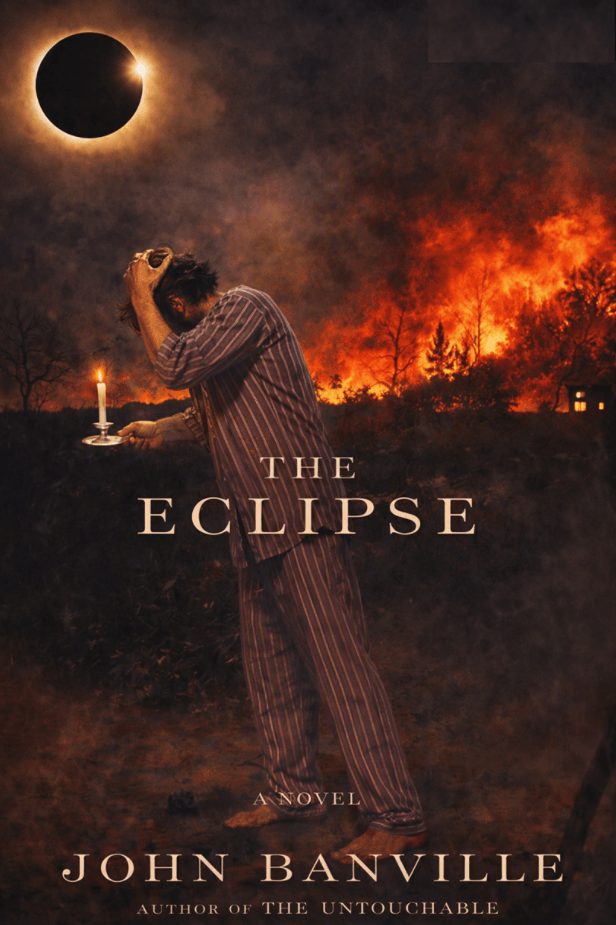
John Banville’s “The Eclipse” isn’t just a novel—it’s a scalpel dipped in acid, slicing through the epidermis of human hysteria.
Forget the metaphysics, the existential murmurings, the candlelit guilt.
This is a mirror held up to the species that once invented fire and now pays €687 a night in Reykjavík to watch it go out for four minutes.
Homo sapiens, that self-proclaimed apex of cognition, has evolved into a selfie-stick with legs, trembling before the cosmic curtain call like a pilgrim at the altar of Instagram.
John Banville’s protagonist wanders through the shadow, haunted by memory and meaning, but the real horror is outside the page: the caravans of enlightenment seekers, the influencers in solar goggles, the astrophysicists turned travel agents.
The eclipse has become a boutique apocalypse, a celestial Black Friday where the moon briefly blocks the sun and humanity loses its collective mind.
The irony drips thicker than Icelandic lava.
The same species that ignores the slow death of its oceans will fly across continents to witness a temporary dimming of its favorite star. They call it transcendence; John Banville calls it pathology.
The candle in his novel burns not for illumination but for mockery—a flicker of sanity in a world that worships darkness as spectacle.
And so the eclipse arrives, and the mammals gasp. They cheer. They cry. They livestream the void.
For a moment, they believe they’ve touched eternity.
Then the light returns, and the hotels send invoices.
John Banville’s laughter echoes through the shadow: the sun was never gone, only our reason.
John Banville’s “The Eclipse” could easily be mistaken for a metaphysical meditation on guilt and memory—until one realizes it’s also a merciless lampoon of the modern mammal’s cosmic vanity.
John Banville’s protagonist, brooding under the shadow of a celestial event, becomes the perfect mirror for a species that treats astronomy like a luxury spa treatment.
The novel’s eclipse is not merely a metaphor for existential darkness; it’s a scalpel slicing through the hysteria of those who pay €687 a night in Reykjavík to watch the sun briefly hide behind its lunar curtain, as if the universe were performing cabaret for their Instagram feeds.
John Banville’s satire burns cold and precise.
His characters don’t just fear the dark—they fetishize it.
The totality becomes a pilgrimage of absurdity, a mass psychosis wrapped in fleece jackets and solar glasses.
Humanity, in his telling, is a herd of anxious primates who mistake cosmic indifference for divine choreography.
The eclipse, that banal astronomical hiccup, becomes a stage for self-importance: scientists sermonize, influencers pose, and philosophers mumble about transcendence while the moon quietly shrugs.
John Banville’s “The Eclipse” is not merely a novel about an astronomical event; it is a scathing, darkly humorous dissection of humanity’s absurd fascination with the mundane disguised as the extraordinary.
The book, published in 1999, unfolds in the shadow of an impending total solar eclipse, an event that, in Banville’s hands, becomes less a spectacle of nature and more a mirror held up to the collective hysteria of modern man.
The eclipse is not the protagonist here—human vanity is.
The narrative follows a man whose life, like the sky during totality, is momentarily plunged into darkness, revealing the cracks in his carefully constructed facade.
But John Banville’s true target is not the individual, but the species: the mammal that will pay €687 a night for a hotel room in Reykjavík, not for comfort or luxury, but for the fleeting, almost religious experience of witnessing the sun swallowed by the moon.
It is a phenomenon that, for all its cosmic grandeur, is reduced to a tourist attraction, a checkbox on the bucket list of the well-to-do and the well-traveled. The irony is delicious. Here we are, a species that has mapped the stars and split the atom, yet we still gather like ancient tribes, our eyes turned skyward, our wallets open, our reason suspended.
John Banville’s prose is razor-sharp, his satire unrelenting.
He exposes the performative piety of the eclipse chaser, the man who will cross continents not for enlightenment, but for the Instagram story, the bragging rights, the illusion of having touched something profound.
The eclipse, in his telling, is not a moment of awe but of absurdity—a celestial joke at our expense.
The characters in “The Eclipse” are not so much observing the event as they are being observed by it, their pretensions and anxieties laid bare under the sudden, unflinching darkness.
And yet, there is something tragically beautiful in this folly.
The eclipse, after all, is a reminder of our insignificance, a brief interruption of the cosmic order that we, in our hubris, believe we control. Banville seems to ask:
What does it say about us that we will pay fortunes to be reminded of our own irrelevance? That we will travel to the ends of the earth to stand in the shadow of the moon, only to return to our lives unchanged, still convinced of our centrality in the universe?
The novel’s brilliance lies in its refusal to romanticize. There are no epiphanies, no grand revelations under the blackened sun. There is only the quiet, unsettling realization that the eclipse, like all things we deem extraordinary, is ultimately just another spectacle in the circus of human vanity. The sky darkens, the crowd gasps, and then—just as quickly—it is over. The sun returns, the bills are paid, and life goes on, as trivial and as self-important as ever.
In the end, “The Eclipse” is not about the eclipse at all.
It is about us: the creatures who will always find a way to turn wonder into commerce, and mystery into a photo opportunity.
John Banville’s satire stings because it is true. And as the next total eclipse approaches, with its hordes of tourists and its inflated hotel prices, one can almost hear his laughter echoing across the decades, a dry chuckle at the eternal, unchanging ridiculousness of man.
In this light, “The Eclipse” joins the lineage of speculative works that expose our terror of the unknown—Asimov’s “Nightfall“, Mark Twain’s “A Connecticut Yankee in King Arthur’s Court” bluffing medieval ignorance, Stephen King’s psychic horror under the 1963 shadow ( “Dolores Claiborne” & “Gerald’s Game“) —all variations on the same theme: the human animal cannot bear to be reminded that the cosmos neither notices nor cares. Banville’s prose, elegant and venomous, turns that realization into artful cruelty.
Tomorrow, millions will stand in the path of totality, mouths open, cameras raised, wallets emptied.
John Banville would smirk: the real eclipse is not celestial but cerebral—the moment when reason flickers and the species forgets that the sun will return whether or not they paid for the view.
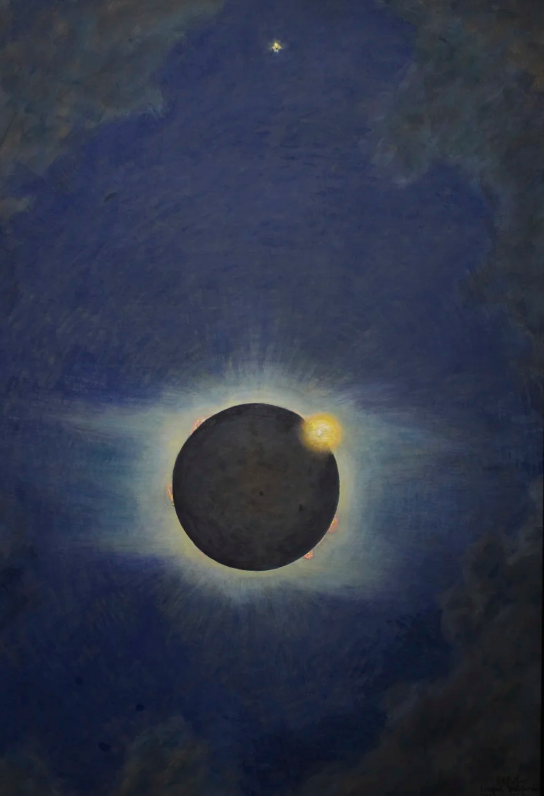
Howard Russell Butler, Solar Eclipse, Lompoc 1923 (1923)
Eclipses in Art, Myth, and the Human Psyche: A Cosmic Comedy of Errors
The human relationship with eclipses is a masterclass in cognitive dissonance.
Here we are, a species that has sent probes to Pluto and split the atom, yet we still gasp in collective awe—or terror—when the moon, that most obedient of celestial bodies, dares to step between us and the sun. Eclipses, whether solar or lunar, have been the ultimate Rorschach test of human civilization: a blank, dark canvas onto which we project our deepest fears, our grandest delusions, and our most absurd commercial ventures.
They are the original cosmic clickbait, a celestial phenomenon so reliably dramatic that they have inspired everything from ancient myths to blockbuster films, from Shakespearean tragedies to the modern-day spectacle of people paying €687 a night to shiver in Reykjavík while staring at the sky through flimsy cardboard glasses.
Let us begin, then, with literature, where eclipses have long served as the ultimate literary device for signaling that something is very wrong.
John Banville’s “The Eclipse” is, of course, the most deliciously cynical entry in this canon, a novel that treats the solar eclipse not as a moment of transcendence but as a cruel joke played on a cast of characters whose lives are as hollow as the corona of the sun.
John Banville’s eclipse is less a celestial event than a psychological one, a moment when the usual illusions of human importance are briefly, mercilessly, snuffed out.
Then there is Isaac Asimov’s “Nightfall”, a short story so beloved it was later expanded into a novel, which posits a world where an eclipse—an event that occurs once every 2,049 years—sends an entire civilization into madness. The premise is almost comically over-the-top: a planet with six suns, where darkness is so rare that the inhabitants have never seen the stars. When the eclipse finally comes, the sudden night triggers a collective breakdown, as if the universe itself has blinked and, in that moment, the fragile human mind has decided it might as well go mad too. It is a brilliant allegory for the human fear of the unknown, though one suspects Asimov, ever the rationalist, was also having a quiet chuckle at our expense.
Mark Twain, that most American of satirists, used an eclipse to even greater comedic effect in “A Connecticut Yankee in King Arthur’s Court”. His protagonist, Hank Morgan, a 19th-century engineer transported back to medieval England, finds himself condemned to burn at the stake. His salvation? The precise knowledge of an impending solar eclipse, which he uses to convince the superstitious court that he is a powerful sorcerer capable of commanding the heavens. The scene is a masterstroke of irony: the same astronomical predictability that allows modern scientists to calculate eclipses down to the second is, in Twain’s hands, repurposed as magic. The joke, of course, is that the medieval peasants are no more foolish than we are. After all, how many of us, in the 21st century, still feel a primal shiver when the sky darkens at noon?
And then there is Stephen King, who never met a cosmic event he couldn’t turn into a psychological nightmare.
In “Dolores Claiborne” and “Gerald’s Game”, the total solar eclipse of July 20, 1963, serves as a supernatural conduit, a moment when the boundaries between minds—and between reality and horror—dissolve.
Stephen King’s eclipses are not just astronomical; they are psychological, a dark mirror held up to the human soul. For King, the eclipse is less about the sky and more about what happens in the shadows it casts on Earth.
If literature has used eclipses as a metaphor for chaos, cinema has embraced them as a metaphor for cool.
“The Chronicles of Riddick” franchise, for instance, features a planet where a month-long eclipse unleashes light-sensitive monsters, turning survival into a race against the clock—or, more accurately, against the calendar. It is a premise so delightfully pulpy that one can almost hear the studio executives greenlighting it with the words, “Yes, but can we get Vin Diesel to growl at the darkness?” Meanwhile, “Pitch Black” (the film that launched the Riddick saga) takes the concept even further, stranding its characters in a world where the eclipse is not just a backdrop but the entire point. The darkness is the villain, and the only weapon against it is, apparently, Richard B. Riddick’s ability to see in the dark. It is a testament to humanity’s enduring love of a good apocalypse—preferably one that can be defeated by a man with glowing eyes.
Television, too, has gotten in on the act. In “The X-Files”, an episode titled Tempus Fugit uses a solar eclipse as the backdrop for a conspiracy involving time loops and government cover-ups, because of course it does. “The X-Files” was, after all, the show that taught us that any unexplained phenomenon, no matter how mundane, could be the key to unlocking a vast, shadowy conspiracy. And if that phenomenon happened to involve the sun disappearing in the middle of the day? All the better.
But what, then, do eclipses mean?
What is their symbolic weight in the grand, messy tapestry of human culture?
The answer, as with most things human, is: it depends on whom you ask.
To the ancient Chinese, a solar eclipse was the work of a celestial dragon devouring the sun, and the only way to scare it off was to bang pots and pans as loudly as possible. (One wonders if the dragon ever rolled its eyes at the racket.)
The Vikings, ever the pragmatists, believed that eclipses were caused by the sky wolves Sköll and Hati finally catching up with the sun and moon in their eternal chase. The solution? More noise, because apparently, the Vikings believed that all cosmic problems could be solved with sufficient decibel levels.
In many cultures, eclipses were omens—usually bad ones.
The ancient Mesopotamians saw them as warnings from the gods, often presaging the death of a king. (One can only imagine the stress levels of Mesopotamian monarchs every time the sky dimmed.)
The Greeks, for their part, interpreted eclipses as signs of divine displeasure, though they also used them as a way to mark time. The historian Herodotus records that the Lydians and the Medes ended a five-year war when a solar eclipse occurred during a battle, which both sides took as a sign to stop fighting. It is a rare moment of cosmic intervention actually working in humanity’s favor—though one suspects the soldiers were simply relieved to have an excuse to go home.
In art, eclipses have often been depicted as moments of sublime terror.
Several paintings captures the eerie, almost apocalyptic quality of a solar eclipse, with figures on a cliff gazing in awe and fear at the darkened sky. It is a scene that could have been lifted straight from a Gothic novel, complete with dramatic poses and a sense of impending doom.
Meanwhile, in literature, eclipses have often been used to signal a turning point, a moment when the natural order is upended and anything can happen.
Shakespeare, ever the dramatist, used a lunar eclipse in King Lear as a portent of the chaos to come.
“These late eclipses in the sun and moon portend no good to us,” declares Gloucester, in a line that could serve as the subtitle for every disaster movie ever made.
Psychologically, eclipses tap into something primal.
The sudden darkness, the unnatural stillness, the way the world seems to hold its breath—it is a reminder that, for all our technology and hubris, we are still at the mercy of forces far greater than ourselves.
The eclipse is a moment of cosmic humility, a brief interruption of the usual order that forces us to confront our own insignificance.
And yet, as Banville so wryly observes, we immediately turn that humility into a commodity.
We travel, we pay, we post, we perform our awe for the benefit of others. The eclipse becomes not a moment of reflection but a moment of consumption, another experience to be ticked off the list.
This, perhaps, is the greatest irony of all.
The eclipse, that most fleeting and ephemeral of cosmic events, has become a permanent fixture in the human imagination. It is a symbol of fear, of wonder, of divine wrath, of scientific triumph, of commercial opportunity. It is all these things and none of them, because in the end, an eclipse is just the moon doing what the moon does, and the sun doing what the sun does, and the Earth spinning merrily along, indifferent to the drama unfolding on its surface.
And yet, we cannot help but look up. We cannot help but gasp, or tremble, or reach for our wallets.
The eclipse, in all its forms, is the ultimate reminder that we are, at heart, a species of storytellers.
We need the darkness to give meaning to the light.
We need the interruption to appreciate the constancy.
And if, along the way, we can turn it into a good story—or a profitable tourist season—so much the better.
After all, what is a solar eclipse if not the universe’s way of winking at us, as if to say, Go on, then.
Make it mean something. And make it mean something we shall, again and again, until the sun itself burns out.

